
How AI Keyword Research Optimizes Content Strategy
In today's hyper-competitive digital landscape, merely creating content isn't enough; it needs to be found by the right audience at the right time. Traditional keyword research, while foundational, often struggles to keep pace with evolving search intent and market trends, leaving valuable opportunities untapped. This article delves into how AI keyword research optimizes content strategy, revealing how cutting-edge tools can uncover high-impact opportunities, predict trends, and pinpoint precise audience needs to drive unparalleled organic growth and engagement.
How AI Keyword Research Optimizes Content Strategy: Unlocking Deeper Insights
Keyword research has always been the bedrock of effective content strategy, yet traditional methods presented significant challenges. Manual data sifting often missed nuanced long-tail opportunities, and keeping pace with evolving search trends was a constant struggle. This frequently led to content underperforming, failing to capture audience attention or achieve desired organic rankings.
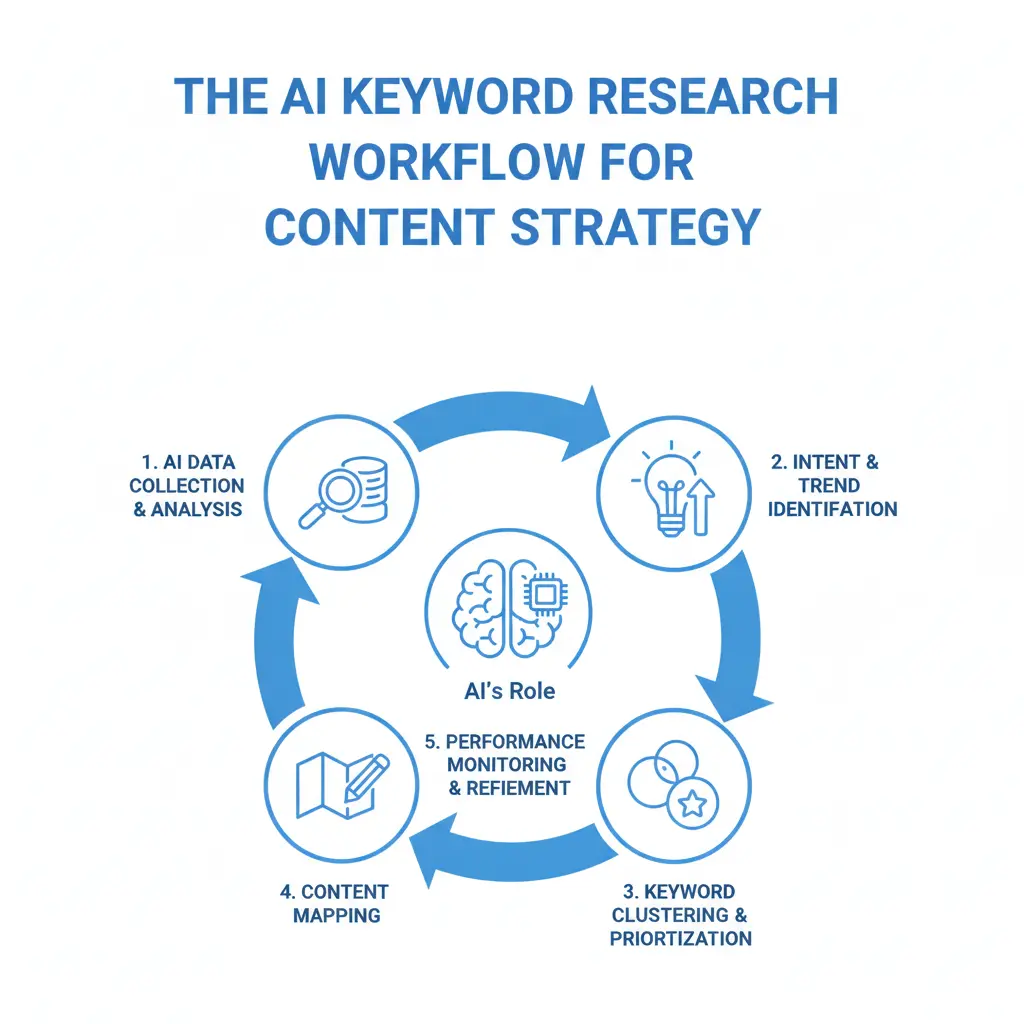
The digital landscape is now redefined by artificial intelligence. Understanding how AI keyword research optimizes content strategy involves leveraging advanced algorithms to process immense datasets. This uncovers hidden trends, predicts intent shifts, and identifies high-value keywords with unprecedented accuracy. Such automation provides deep AI-driven SEO insights, transforming discovery into a powerful strategic advantage.
Ultimately, AI empowers a truly data-driven content strategy. By precisely understanding audience language and intent, businesses create highly relevant, engaging content that drives traffic and achieves measurable results. This shift from guesswork to informed, efficient decision-making is critical for unlocking content potential in today's competitive digital environment.
Key Ways AI Transforms Keyword Research for Content Strategy
- Uncover Niche Long-Tail Opportunities: AI analyzes vast datasets to find less competitive, highly specific search queries that human researchers often miss, driving targeted traffic for content performance optimization. This AI-powered keyword discovery process ensures broader audience reach.
- Anticipate Emerging Search Trends: Leveraging historical data and real-time signals, AI tools provide predictive keyword analysis, allowing content strategists to create timely content that captures future audience interest and dominates new niches before competitors.
- Identify Competitor Keyword Gaps: AI-powered platforms analyze competitor rankings and content, revealing keywords they rank for that you don't, or areas they've overlooked, offering strategic insights for your content strategy to gain a competitive edge.
- Refine User Intent Understanding: AI algorithms go beyond surface-level keyword matching, interpreting the true intent behind search queries (informational, navigational, transactional) to ensure your content optimization precisely answers user needs, leading to higher engagement and conversions.
- Cluster Keywords Semantically: AI groups related keywords into thematic clusters, enabling the creation of comprehensive content that covers a topic in depth, improving topical authority and boosting visibility in semantic SEO.
- Automate and Scale Research Efforts: AI significantly reduces the manual effort and time required for extensive keyword research, allowing marketers to analyze massive datasets and generate actionable insights at a scale impossible for human teams, thus enhancing overall marketing analytics efficiency.
Traditional vs. AI-Powered Keyword Research: A Comparative Analysis
| Feature/Aspect | Traditional Method | AI-Powered Method |
|---|---|---|
| Speed & Efficiency | Relies on manual keyword analysis, often involving extensive spreadsheet work and multiple tools. This process is time-intensive and limits the scope of research. | Offers rapid, automated keyword discovery, processing vast datasets in minutes. This significantly boosts productivity and allows for comprehensive market analysis. |
| Data Depth & Accuracy | Limited by human capacity and tool integrations. Data can be fragmented, leading to less precise insights and missed opportunities. | Aggregates and analyzes massive volumes of data from various sources, providing deeper insights into search volume, competition, and advanced analytics with higher accuracy. |
| Trend Prediction | Primarily reactive, identifying current trends based on historical data. Forecasting future shifts is largely based on intuition and limited data sets. | Utilizes predictive analytics to identify emerging topics and future keyword trends. This provides a proactive edge in content planning and competitive intelligence. |
| User Intent Understanding | Requires significant manual interpretation of SERPs and search queries to infer user intent. This method is often subjective and prone to human bias. | Employs natural language processing (NLP) to accurately decipher user intent behind queries, categorizing keywords by informational, navigational, commercial, or transactional intent, crucial for content optimization. |
| Scalability & Resource Cost | Scales poorly; adding more keywords or markets requires proportional increases in manual effort and time, leading to higher labor costs. | Highly scalable. Can analyze millions of keywords across multiple markets with minimal additional effort, reducing long-term resource cost and enabling broader keyword strategies. |
Embrace the Future: AI as Your Content Strategy Catalyst
The integration of Artificial Intelligence is fundamentally revolutionizing how businesses approach content creation, particularly in keyword research. AI's analytical prowess uncovers high-intent, long-tail phrases and emerging trends, enabling a level of precision previously unattainable. Understanding how AI keyword research optimizes content strategy is crucial for developing more targeted, effective, and high-performing content that truly resonates with audiences and drives measurable business outcomes.
This transformative impact empowers companies to significantly improve organic rankings, traffic, and conversion rates. The core benefit of how AI keyword research optimizes content strategy lies in its ability to streamline processes and elevate content performance. To unlock sustained growth and maintain a competitive edge, businesses must explore AI-powered solutions for automated SEO tasks and advanced analytics, ensuring their content strategy is not just current, but future-proofed for success.