Automated Link Building Tools for SaaS: What to Automate, What to Avoid, and Which Tools Do It
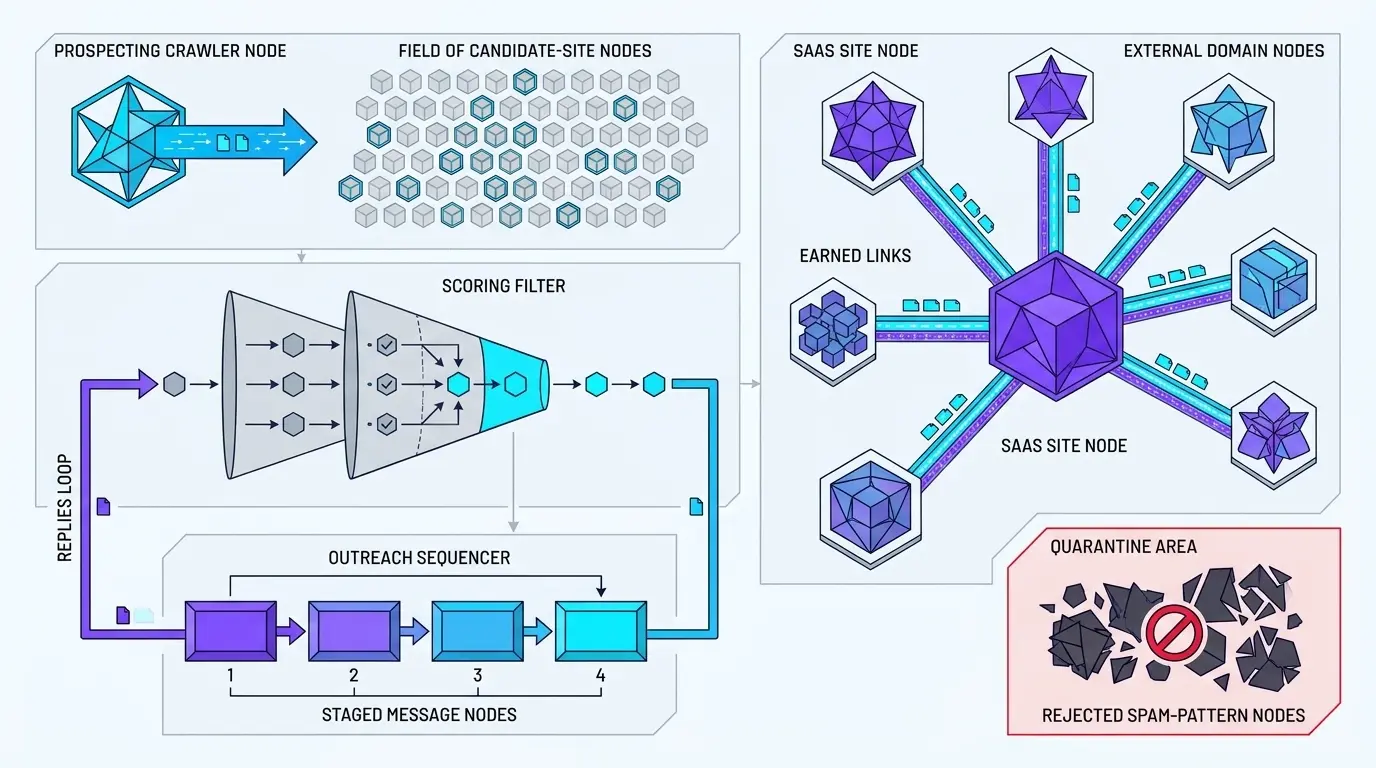
Automated link building tools for SaaS can safely take over prospecting, qualification, outreach sequencing, and tracking, which together are most of the hours a link builder spends. What they cannot safely automate is the acquisition itself at scale: buying placements, spinning up networks of sites, or mass-posting generic guest articles, all of which Google's spam policies name directly. This guide draws that line, compares six tools on what each one actually automates, and lays out the link-building playbook that works for a SaaS company in 2026.
TL;DR
- Automate the work around the link (finding sites, qualifying them, sending and following up, tracking results). Keep a human on the relationship and the content.
- Google's spam policies prohibit buying or selling links that pass ranking signals, large-scale guest posting with keyword-rich anchors, and private blog networks. Tools that promise "links on autopilot" are usually selling one of these.
- The six tools below split into outreach platforms (BuzzStream, Pitchbox, Respona), building blocks (Hunter plus a sequencer, Ahrefs Content Explorer), and one platform that runs the campaign itself.
- The SaaS tactics still earning links: integrations pages, comparison pages, original data, and partner co-marketing.
Want links without running outreach yourself? Book a 30-minute demo to see how the outreach agent would prospect for your site, with you approving every pitch. Book a demo →
Automate the process, never the link itself
Google's spam policies, published in Search Central, are plain about what counts as link spam: buying or selling links that pass PageRank, excessive link exchanges, large-scale article or guest-post campaigns with keyword-rich anchor text, automated programs that create links to your site, and links from private blog networks built to manipulate rankings. The penalty for crossing these lines ranges from the links being ignored to a manual action against the whole site.
Read that list again and notice what is not on it. Nothing prohibits using software to find relevant sites, check their quality, write a personalized email, send it on a schedule, and record whether a link appeared. Those are the time sinks, and they are the parts a tool should own.
Safe to automate
- Prospecting: pulling lists of sites that link to competitors, mention your category, or publish on your topic.
- Qualification: filtering by traffic, topical relevance, outbound link patterns, and signs of a link farm (sponsored-post pages, hundreds of unrelated outbound links).
- Contact discovery and verification: finding the right editor and confirming the address is deliverable.
- Sequencing: the first email, two follow-ups, and a stop rule when someone replies or asks not to be contacted.
- Tracking: detecting when a link goes live, whether it is followed, and whether it stays.
Not safe to automate
- Paying for placements at scale, including "sponsored post" marketplaces that do not use
rel="sponsored". - PBNs and expired-domain networks, however well disguised.
- Mass guest posting of templated articles with exact-match anchors.
- Fully generated pitches sent without a human reviewing the angle. Editors recognize them and the domain's reply rate collapses.
The sections that follow apply this split to each tool.
Six tools, and what each one actually automates
Scalnex
An AI SEO automation platform in which link building is one agent rather than the whole product. The agent prospects guest-post and resource-page targets based on your keyword clusters and competitor backlink gaps, qualifies them against relevance and quality filters, drafts a personalized pitch and a draft article aligned to your brand kit, runs the outreach sequence, and tracks links earned alongside the rank tracking for the pages those links point to. The distinction from outreach platforms is that it executes the campaign end to end with your approval gates, instead of giving you a workspace to run it in. It fits a SaaS team with no dedicated link builder that wants a steady cadence of editorially placed links without hiring for it.
BuzzStream
BuzzStream is a relationship-management CRM for outreach. It automates contact discovery from a list of URLs, stores every interaction with a site, and runs email sequences with templates and merge fields. Its strength is history: when a teammate contacts a site you pitched eight months ago, BuzzStream shows the thread. It does not prospect for you or write content. Best for an in-house team or agency that runs ongoing outreach and needs to coordinate across people.
Pitchbox
Pitchbox is an outreach platform with prospecting built in: keyword-based searches, competitor backlink imports, and integrations with SEO data providers to pull authority and traffic metrics into the prospect list. It automates sequencing, follow-ups, and reporting, and includes workflow stages so a campaign manager can see where every prospect sits. Aimed at agencies and larger in-house teams running several campaigns at once.
Respona
Respona combines prospecting (search engine, podcast, and news results), contact finding, and AI-assisted personalization in one sequencer. It is designed for the "write something, then find people who would care" workflow, which suits SaaS companies promoting original data or a new guide. Lighter than Pitchbox on campaign management, faster to get a first campaign out.
Hunter plus a sequencing tool
Hunter finds and verifies email addresses for a domain or a named person. Paired with a sequencer (its own Campaigns feature, or a general sales tool such as Lemlist or Instantly), it gives you a minimal outreach stack: you supply the prospect list, Hunter supplies the addresses, the sequencer sends and follows up. No prospecting, no link tracking, no quality filters. Right for a founder running a small, hand-picked campaign.
Ahrefs Content Explorer for prospecting
Ahrefs is a research tool, not an outreach tool, but Content Explorer is one of the best prospecting sources available: search any topic, filter by domain rating, traffic, publish date, and whether the page links to a competitor, and export the list. Pair it with any of the tools above for sending. If you are weighing Ahrefs against an execution-focused platform for the backlink side specifically, the backlink checker comparison sets out where each one is stronger.
Comparison table
| Capability | Autonomous platform (above) | BuzzStream | Pitchbox | Respona | Hunter + sequencer | Ahrefs Content Explorer |
|---|---|---|---|---|---|---|
| Prospecting | Automated from keyword clusters and competitor gaps | Import your own lists | Built-in keyword and competitor search | Built-in search across web, podcasts, news | None (bring your list) | Strong search and filters; export only |
| Personalization | AI-drafted pitch and article from brand kit, human approval | Templates with merge fields | Templates, merge fields, AI assist | AI-assisted per-prospect lines | Templates with merge fields | N/A |
| Sending and follow-ups | Automated sequence with stop rules | Automated sequences | Automated sequences with workflow stages | Automated sequences | Automated sequences | N/A |
| Tracking links earned | Yes, tied to rank tracking of target pages | Manual or via integration | Yes, with reporting | Yes | No | Yes (Site Explorer), separate from outreach |
| Link quality controls | Relevance and quality filters before outreach | Manual review | Metrics pulled from SEO data providers | Basic authority filters | None | Domain rating, traffic, outbound link filters |
| Who it fits | SaaS team with no link builder | Teams coordinating ongoing outreach | Agencies, larger in-house teams | Content-led SaaS promoting assets | Founders running small campaigns | Anyone, as a prospecting source |
Automated link building service: when to hand off the whole loop
A tool automates steps you still run. An automated link building service runs the loop for you: prospecting, qualification, pitching, follow-ups, placement checks and reporting. The choice comes down to whether anyone on your team has the hours to operate a tool every week. Most SaaS teams under ten people do not.
What a done-for-you service should run
- Prospecting from your keyword gaps, not a generic site list: sites that already link to competitors for the topics you want to rank for.
- Qualification against spam signals: real organic traffic, topical relevance, no sell-a-link footprint.
- Pitches and articles written for the host site's readers, in your brand voice.
- Follow-ups, placement verification and reporting that tie each live link to the page and keyword it supports.
What you should keep
You approve the target list, every pitch topic and the anchor text. A service that will not show you its prospect list before outreach starts, or that offers a guaranteed number of links from "partner sites", is selling a link network. Google's spam policies treat that as link buying, and it is the fastest way to lose the rankings you were trying to build.
Questions to ask before you sign
- Can I see a sample prospect list for my site before we start?
- How do you qualify a site, and what makes you reject one?
- How do you verify a link is live, and what happens if it is removed?
- Do you pay sites for placement? (The only acceptable answer is no.)
The SaaS link-building playbook that works in 2026
Tools make the process cheaper. Whether anyone links to you still depends on having something worth linking to. Four assets consistently earn links for SaaS companies, and each one pairs with a specific outreach motion.
Integrations pages
Every tool you integrate with has a partner directory, a marketplace listing, and often a blog that covers new integrations. Build one page per integration ("Acme + Slack: how it works"), then request the directory listing and send the partner's marketing team a short note. These are among the easiest relevant links a SaaS company can get, and they compound as your integration count grows.
Comparison and alternatives pages
"Acme vs Competitor" and "Competitor alternatives" pages attract links from review roundups, Reddit threads, and newsletters because they answer a question people are actively arguing about. Write them fairly, keep them current, and use outreach to put them in front of writers who already cover the category.
Original data
Anonymized usage data from your own product, a survey of your customer base, or a benchmark built from public sources gives journalists and bloggers a number to cite. One good data study a quarter, promoted through a sequenced campaign to writers who covered similar studies, outperforms a year of generic guest posts.
Partner co-marketing
Joint webinars, shared templates, and co-authored guides with a non-competing SaaS company produce two links per asset (one from each partner's site) plus the audience overlap. This is relationship work, which is exactly where automation should stop and a person should pick up.
Guest posting still has a place in this playbook when the site is genuinely relevant, the article is written for its readers, and the link is contextual rather than a keyword-stuffed bio line. That is the version of guest posting the tools above should be sequencing. For how this fits into a broader SaaS SEO program, see the SaaS industry page.
FAQ
Is automated link building safe?
Automating prospecting, qualification, outreach sequencing, and tracking is safe and within Google's guidelines. Automating link acquisition itself, meaning buying placements at scale, using private blog networks, or mass-posting templated guest articles with keyword anchors, violates Google's spam policies and risks a manual action. Judge any tool by which half it automates.
How many links per month should a SaaS build?
There is no safe universal number; it depends on your site's current profile and your competitors'. A practical approach is to match the pace of the competitors ranking where you want to rank, prioritize relevance over count, and keep growth steady rather than spiky. For most early-stage SaaS companies, a handful of genuinely relevant links per month beats dozens of weak ones.
What is a good reply rate for link building outreach?
Well-targeted, personalized campaigns commonly see reply rates in the range of 5 to 15 percent, with a fraction of replies converting to a live link. Generic templated blasts often fall below 2 percent. Treat your own baseline as the benchmark: improve targeting and the pitch angle until the rate rises, and stop any sequence that triggers unsubscribe requests.
Do guest posts still work for SEO?
Yes, when the host site is topically relevant, the article is written for that site's readers, and the link sits naturally in the content. Google's policies target large-scale guest posting with keyword-rich anchors, not editorial contributions. A few well-placed posts on sites your buyers read are worth more than a volume program on general-interest blogs.
See outreach that runs itself, with you on the approval gate
If your SaaS has no one whose job is link building, book a Scalnex demo. We will show you how the link-building agent prospects from your keyword clusters, drafts pitches and articles in your brand voice, runs the outreach sequence, and reports the links earned next to the rankings they moved, with a human approving every send.