
Best Rank Tracker Software to Elevate Your SEO
In the fast-moving world of modern SEO, relying on guesswork to monitor your search visibility is a guaranteed way to fall behind competitors. Investing in the right rank tracker software eliminates this blind spot, delivering real-time keyword insights that reveal exactly how your organic campaigns perform across dynamic search engine result pages. Whether you are scaling an enterprise brand or optimizing an agency’s workflow, accurate data fuels smarter strategic decisions. In this guide, we explore the top solutions on the market to help you choose the ideal platform for your growth goals.
Rank tracker software is an automated SEO technology platform that monitors website search engine result page (SERP) positions for targeted keywords across desktop and mobile devices. It systematically records daily ranking fluctuations, maps search intent, and tracks competitive visibility across distinct geographic locations. Rather than checking rankings manually, marketing teams use rank tracker software to gain accurate performance telemetry, identify algorithmic penalties, and measure organic revenue impact.
For companies operating in competitive business hubs such as Delhi, pan-India, or fast-paced international software markets, manual keyword position tracking wastes valuable engineering and marketing hours. Search engines personalize query results by user location, device specifications, browsing history, and real-time algorithmic shifts. A dedicated automated SEO platform solves this complexity by crawling SERP data via localized proxies, delivering reliable organic keyword visibility data to decision-makers.
At Scalnex, modern tracking goes beyond passive observation. By combining smart keyword monitoring with automated link building and content workflows, businesses transform diagnostic data into decisive ranking recoveries.
Core Capabilities of Modern Automated Rank Tracker Software
Selecting the right tracking solution requires understanding what technical infrastructure drives real commercial outcomes in 2026.
- Real-Time Geo-Targeted Tracking: Collects hyper-local search positions at the postal code and city level, such as Delhi or regional hubs, avoiding skewed global averages.
- Automated Competitor Benchmarking: Continuously scrapes organic market share changes to reveal when competing domains win featured snippets or AI Overviews.
- AI Rank Volatility Alerts: Automatically notifies teams when sudden ranking drops happen, diagnosing potential indexation issues or core algorithm updates.
- Search Intent Classification: Categorizes keywords by transactional, informational, navigational, or commercial intent to prioritize pipeline value.
- Automated Action Triggers: Connects position drops to execution workflows, such as updating internal links or refreshing on-page content.
The table below summarizes how each modern rank tracking feature directly maps to commercial outcomes for marketing teams:
| Core Feature | Operational Mechanism | Measurable Business Outcome |
|---|---|---|
| Hyper-Local SERP Crawling | City-level IP proxy querying across desktop and mobile | Eliminates reporting errors in target regional markets |
| Algorithmic Volatility Detection | Continuous statistical variance tracking across core seed terms | Enables immediate response before organic pipeline drops |
| Automated Intent Categorization | Natural language processing of query results and top-ranking assets | Focuses budget on keywords that generate inbound leads |
| Competitor Keyword Conquesting | Automated tracking of competitor URL movements and backlink deltas | Identifies market gaps and quick-win keyword targets |
| Actionable Workflow Triggers | Webhooks and automated task dispatching based on rank thresholds | Cuts response time from weeks to hours for dropping URLs |
Comparing Rank Tracker Software: Legacy Trackers vs. Scalnex Automation
Legacy tracking tools simply record drops; next-generation platforms resolve them. Outdated tools offer static charts, forcing digital marketing teams to spend hours manually diagnosing rank decay before taking corrective measures.
| Platform Capability | Legacy Rank Trackers | Semrush / Ahrefs Suite | Scalnex AI Automation |
|---|---|---|---|
| Update Frequency & Geo-Precision | Weekly updates; high latency; weak city-level fidelity | Daily updates; solid international tracking; basic local filters | On-demand and daily tracking; street-level and city-level accuracy |
| AI Keyword Intent Mapping | Manual keyword tagging via spreadsheets | Static categorizations (Informational, Commercial) | Dynamic real-time intent mapping based on live SERP layouts |
| Automated Action Triggers | None; manual dashboard exports | Standard email alerts without remediation recommendations | Automated link building triggers and workflow notifications |
| Integrated Content Optimization | No native content correction mechanisms | Add-on content auditing modules without automated fixing | Direct connection to AI content editors and brief generators |
| Cost vs Inbound ROI | Low subscription cost; massive labor overhead | Expensive seat tiers; requires dedicated analytical talent | High ROI; combines tracking, outreach, and optimization in one platform |
While industry standard suites provide massive databases, automated rank tracker software provides actionable intelligence that reduces the time between identifying a SERP drop and resolving it.
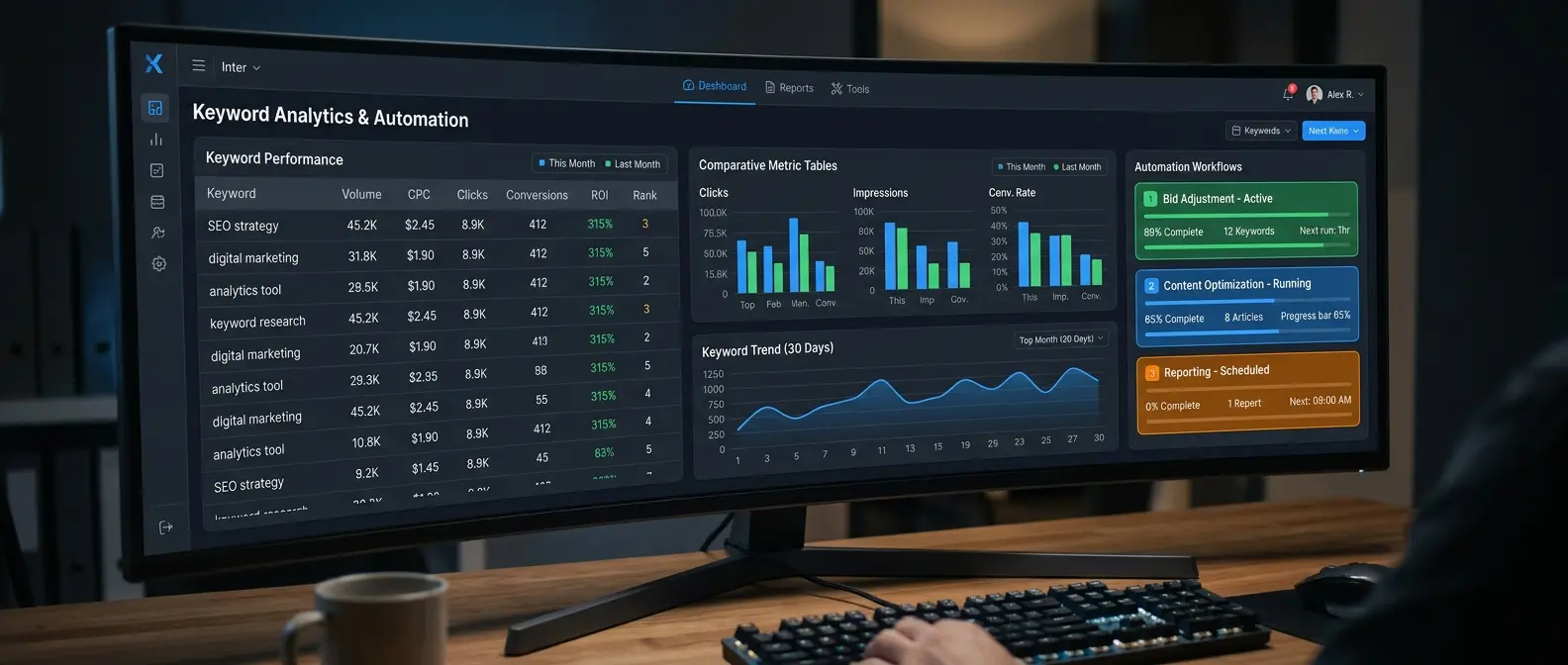
What Features to Look for in Rank Tracker Software
Evaluating enterprise ranking tools requires a focus on data accuracy and system interoperability. The primary pitfall for growing brands is purchasing vanity software that displays thousands of keywords without showing which positions generate qualified pipeline.
First, verify reporting flexibility. Modern growth marketing teams require rank tracker software integrations with Google Looker Studio to combine organic keyword positions with paid search, CRM pipeline data, and Google Analytics 4 conversions. Centralized dashboards keep executives aligned on organic performance without exporting endless CSV files.
Second, review automated rank tracker software reporting features. High-performing agencies and in-house teams rely on scheduled, white-label PDF generation and real-time anomaly alerts. When unexpected volatility strikes, automated diagnostics should pinpoint whether the issue is algorithmic, technical, or backlink-related. Incorporating advanced analytics ensures your organic search strategy adapts quickly to market shifts.
Third, understand update frequency. Teams often ask how often should rank tracker software update SERPs. In fast-moving sectors like SaaS, real estate, and finance, weekly updates are inadequate. A robust platform should offer daily updates with on-demand SERP checks when deploying site-wide schema updates, publishing major refreshes, or migrating domain infrastructure.
Free SERP Checker vs Paid Rank Tracker
A free SERP checker returns a single snapshot of the results page for one keyword at the moment you run it. A paid rank tracker records positions on a schedule, keeps the history, and separates results by device and location. The question is whether you need occasional spot checks or continuous data that your revenue depends on.
| Dimension | Free SERP Checker | Paid Rank Tracker |
|---|---|---|
| Cadence | Manual, one query at a time | Scheduled daily crawls plus on-demand checks |
| Location accuracy | Country-level results, often skewed by the checker's own location or cookies | City and postal-code level results on desktop and mobile |
| History | None; the result disappears when you close the tab | Months of position history to separate normal volatility from real drops |
| Volume | Rate limits and CAPTCHAs after a handful of queries | Hundreds to thousands of keywords per project |
| Competitors | Checked by hand, one URL at a time | Automatic tracking of competitor movements and share of voice |
Free checkers are fine for verifying a single ranking after you publish. Once you track more than about ten commercial keywords, or manual checks take more than a couple of hours a week, a dedicated tracker pays for itself in time saved and drops caught early.
Automated Reporting and Looker Studio Integrations
Rank data only helps if the people who make decisions see it. Good trackers send scheduled reports and alerts instead of waiting for someone to log in:
- Threshold alerts: notify the team by email, Slack or webhook when a commercial keyword enters or falls out of the top three.
- Scheduled, white-label reports: weekly or monthly summaries in your agency's branding, with no manual exports.
- Intent and device breakdowns: show whether movement is on transactional or informational terms, and on mobile or desktop.
- Share of voice: your organic visibility relative to named competitors, which is usually the clearest metric for executives.
For teams that already report in Google Looker Studio, connect rank data through a connector or API rather than CSV exports pasted into Google Sheets. Exports go stale quickly and break as keyword lists grow. Once rank data is in Looker Studio, blend it with Google Search Console on the URL and query dimensions, then with Google Analytics 4 conversions. Your dashboard then shows the position, the impressions and clicks, and the leads or revenue each ranking produced.
| Reported Metric | Suggested Frequency | Why It Matters |
|---|---|---|
| Local pack rankings | Daily | Drives calls, direction requests and walk-ins |
| Commercial keyword positions | Daily, summarised weekly | Early warning for lead and sales volume |
| Search intent visibility | Weekly | Shows whether gains are on terms that convert |
| Share of voice | Monthly | Tracks overall authority against competitors |
How to Track Rankings for an Ecommerce Store
To track rankings for an ecommerce store, group keywords by category, sub-category and product, map each keyword to the URL you want to rank, and track Shopping and product-grid results alongside the organic listings. Check positions daily around sales and seasonal launches, when they move fastest. Online stores rank thousands of category and product URLs whose visibility shifts with stock levels, seasonal collections and competitor promotions, so the details matter:
- Segment keywords by catalog hierarchy: separate category terms, filtered sub-category terms and individual product or SKU terms, so a drop on one product is not hidden inside a brand-level average.
- Track SERP features, not just blue links: Google Shopping carousels, Popular Products grids and image packs often sit above the first organic result.
- Map the intended ranking URL: check that canonical tags and faceted parameters (colour, size, brand) do not let a filtered or duplicate URL outrank the category page you want.
- Watch out-of-stock pages: flag ranking products that go out of stock so they can be restocked, redirected or replaced before they lose position.
Best Rank Tracker for Ecommerce
The best rank tracker for ecommerce is one that works at catalogue scale and understands product results, not just blue links. Look for keyword grouping by category and product, tracking of Google Shopping and Popular Products features, alerts when a filtered or duplicate URL starts ranking in place of your category page, and a Search Console connection so you can see which rankings bring in shopping traffic. Price matters less than whether it can cover your whole catalogue without forcing you to trim the keyword list.
Rank Tracking for Real Estate Companies
Property searches are hyper-local. A query like "flats for sale" or "office space for lease" returns different map pack results a few streets apart, so city-wide tracking misses most of what decides leads. Real estate teams should prioritise:
- Neighbourhood and postal-code tracking: track rankings at the locality level for every area you list in, not just the city.
- Local 3-pack monitoring: the map pack is where buyers and sellers call agencies directly, so track it alongside organic results.
- Benchmarking against portals: compare your visibility with large property aggregators to find the neighbourhood and listing-type keywords you can realistically win.
- Buyer and seller terms tracked separately: rankings for "sell my house" and "homes for sale" feed different pipelines.
Rank Tracking Software with Built-in SEO Tasks
Most rank trackers stop at a chart: they show that a keyword dropped and leave the fix to you. Rank tracking software with built-in SEO tasks turns each movement into a next step, such as refreshing a page that slipped, rewriting a title that ranks but does not get clicked, or adding a supporting article for a keyword that is climbing. In Scalnex, tracked keyword positions and Search Console data feed a daily review that puts those tasks on your content calendar, so your team works on the fix instead of diagnosing the drop.
What are the advantages of using automated rank tracking software?
Automated rank tracking software checks your positions on a schedule, so you see every movement without running searches by hand. The main advantages are that drops are caught early, results match the location and device you choose, and position history shows whether a change is noise or a trend. When the tracker also connects rankings to Search Console clicks, you can see which positions actually bring in traffic, and the hours saved on manual checks go into improving pages.
Common Rank Tracking Mistakes That Mislead Businesses
Tracking rank data incorrectly produces bad strategic choices. The most frequent error is overvaluing broad vanity terms while ignoring high-intent, long-tail queries. Ranking number one for a high-volume educational query that yields zero sales leads can drain internal resources away from high-intent commercial terms.
Another common mistake is neglecting localized search variance. Search engines personalize results based on user geography. Monitoring search positions from a single national data center distorts true market reality. Tracking must be evaluated through geo-specific IP endpoints to reveal local market share accurately.
Furthermore, relying strictly on single-day snapshots can cause unwarranted panic. Marketing managers frequently ask why organic keyword rankings drop suddenly or why are my Google keyword rankings fluctuating daily. Google routinely tests algorithmic updates through temporary testing buckets, causing positions to fluctuate before stabilizing. Tracking platforms must provide 30-day moving averages and historical trend lines to differentiate standard volatility from genuine indexing penalties.
How Rank Tracking Improves SEO ROI
Rank tracking improves SEO ROI by showing which pages sit just below the positions that get clicked, so effort goes where it pays back. Moving a commercial page from position 9 to position 3 can multiply its clicks several times over, while the same work on a page stuck at position 40 changes almost nothing. Tracking also catches drops within days instead of at the end of the month, before lost rankings show up as lost leads.
Benefits of Automated Rank Tracking for Lead Generation
Accurate ranking metrics serve as an early warning system for inbound lead volume. When commercial landing pages drop from position two to position five, inbound lead generation can decrease significantly overnight. Utilizing smart keyword tracking lets marketing leaders protect pipeline before revenue dips appear in monthly reports.
By unifying rank telemetry with automated link building and content optimization workflows, organizations turn passive charts into revenue-generating engines. Integrating rank tracking directly into proactive SEO workflows eliminates operational lag, ensuring your highest-converting landing pages consistently dominate page-one search results.
To understand the official mechanics behind how search engines discover, crawl, and position landing pages, review the official documentation provided by Google Search Central.
Maximize Search Authority with Intelligent Rank Tracking
Passive rank tracking is no longer sufficient in an era of conversational AI and rapidly changing search result layouts. Enterprise businesses in competitive verticals cannot afford to spend weeks identifying drop-offs manually. Tracking data must immediately trigger necessary on-page updates, technical audits, and link acquisition campaigns.
Scalnex provides the modern infrastructure needed to replace disjointed SEO stacks. By integrating daily position tracking with automated content briefs and link building campaigns, your team can maintain continuous top-tier visibility.
Ready to automate your keyword tracking and dominate search results? Schedule a Scalnex platform demo to turn real-time SERP insights into organic market share.