Google Rank Checker API Integrations for Agencies
Manual rank tracking fails the moment your agency scales past twenty client accounts. Scraping SERPs manually drains engineering resources, leads to IP blocks, and produces inconsistent reporting data that erodes client trust. Implementing dedicated **google rank checker api integrations for agencies** resolves this bottleneck by piping real-time, geo-specific rank data directly into your custom dashboards and automated workflows. Below, we examine the system architecture required to build a resilient, high-volume tracking pipeline that cuts operational costs and eliminates reporting lag.
What Are Google Rank Checker API Integrations for Agencies?
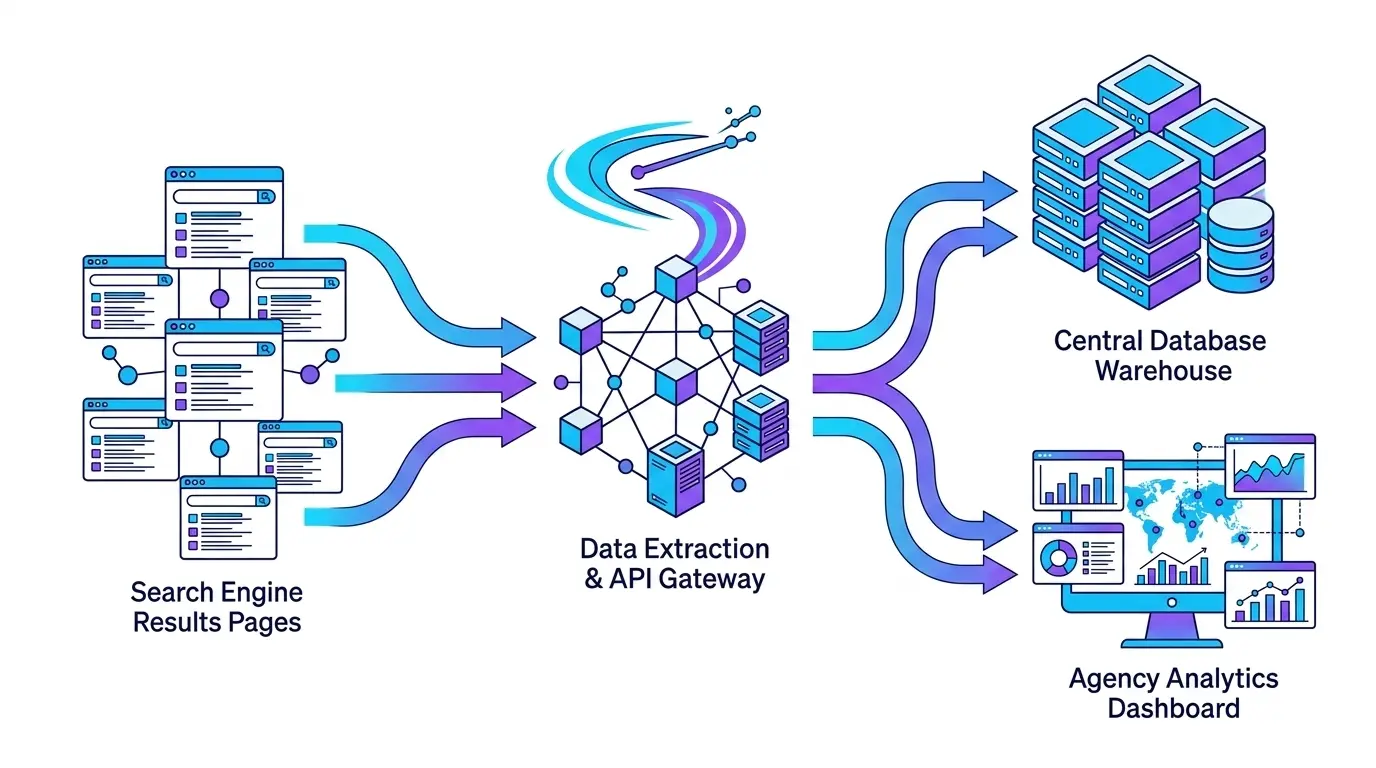
Google rank checker api integrations for agencies are programmatic data pipelines that connect automated search engine results page (SERP) extraction endpoints directly into agency client portals, BI warehouses, and execution workflows, bypassing manual reporting friction. Agencies frequently ask: is there a Google keyword ranking API? While Google does not provide an official native rank tracking API through Google Search Console or Google Ads, dedicated third-party rank checker and SERP APIs fill this gap by programmatically scraping, parsing, and normalizing search results across any geo-location, language, and device in real time.
- Eliminating Legacy Diagnostic Suite Latency: Programmatic endpoints deliver instantaneous positional polling across desktop and mobile user-agents, bypassing stale 24-hour web refreshes and seat-based software locks.
- Scaling Client Query Volumes: Bulk SERP endpoints effortlessly scale past 100,000+ keywords across multi-tenant agency setups without hitting UI session limits or IP blocks.
- Unified Agency Reporting Architecture: Structured JSON payloads route directly into BigQuery, Snowflake, Looker Studio, or custom white-label client dashboards alongside conversion and analytics telemetry.
- Enabling Autonomous Optimization Loops: Granular rank telemetry feeds directly into automated workflows, triggering programmatic internal linking, schema updates, or content re-optimization when target rankings slip.
Legacy SEO Dashboards vs. Programmatic API Integrations: Operational Comparison
Transitioning from browser-based SEO portals and manual rank tracking software to programmatic API integrations restructures how digital agencies consume, store, and act on SERP intelligence across hundreds of client accounts.
| Evaluation Metric | Legacy Diagnostic Suites | In-House Scraper Scripts | Autonomous API Pipelines |
|---|---|---|---|
| Data Freshness & Polling Latency | 12–24 Hour Polling Intervals | On-Demand (Subject to Proxy & Captcha Latency) | Real-Time / Webhook Driven (<5s Latency) |
| Infrastructure & Maintenance Cost | High Subscription SaaS Seats ($500–$2,000+/mo) | High Engineering Maintenance & Proxy Overhead | Cost-Effective Pay-As-You-Go ($0.50–$2.00 / 1k Queries) |
| Scalability (10k+ Keywords) | Restricted by Plan Tier & User Seats | Frequent IP Bans, Headless Browser Crashes | Unlimited Horizontal Concurrency via Cloud Endpoints |
| Workflow Automation Capability | Passive Visual Dashboards & Manual CSV Exports | Custom Cron Scripts & Local Storage | Autonomous Webhook Triggers & Automated SEO Remediation |
| Reporting Protocol | Proprietary Web Interface & Branded PDFs | Raw Terminal Output / Fragmented Files | Normalized JSON Streamed to Looker Studio, Power BI & Warehouses |
For modern digital marketing agencies managing multi-location franchises or enterprise e-commerce portfolios, seat-based rank tracking software introduces artificial data silos and massive software markup. Transitioning to dedicated rank tracking APIs cuts data acquisition costs by up to 80% while feeding clean positional telemetry directly into automated client reporting engines.
How to Deploy a Google Rank Checker API into Your Agency Architecture
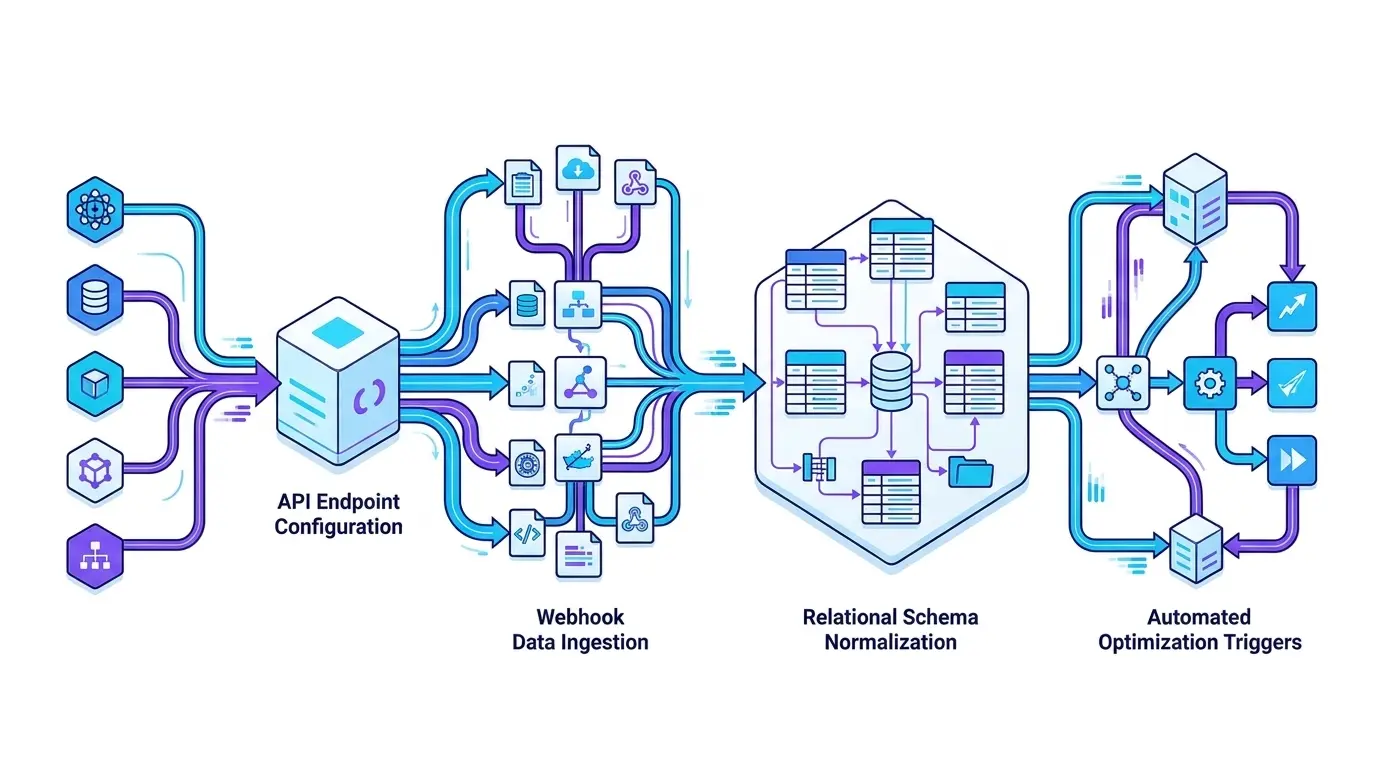
- Define query parameters and localization targets: Configure exact latitude/longitude coordinates, canonical UULE parameters, language codes, and mobile user-agent headers for each client domain. Capturing precise local SERP grids prevents generic national data from misleading local and multi-location clients.
- Provision secure API credentials and establish rate-limiting rules: Generate environment-isolated API tokens and configure token-bucket rate limiters within your backend microservices. Managing concurrency queues prevents HTTP 429 throttling errors during peak bulk reporting cycles.
- Build the endpoint ingestion pipeline: Deploy asynchronous webhook listeners to consume batched JSON payloads instead of maintaining blocking HTTP connections. Asynchronous ingestion decouples SERP data collection from your frontend rendering stack, minimizing server resource consumption.
- Normalize rank data schemas into an internal database: Ingest and map raw API responses into structured relational tables in PostgreSQL, Snowflake, or BigQuery. Ensure schemas track organic ranks, pixel ranks, local pack placements, knowledge panels, and AI Overview citations in dedicated columns.
- Map position delta triggers to automated client interventions: Establish automated webhook listeners that trigger immediate optimization alerts when high-value commercial keywords decline. Connecting APIs with platforms like Scalnex AI allows teams to orchestrate autonomous SEO infrastructure, instantly initiating programmatic content refreshes and entity re-alignments.
- Validate extraction accuracy against direct search results: Schedule automated integrity audits that cross-examine returned API ranking coordinates against live rendered HTML captures. Continuous validation safeguards multi-client dashboards against unexpected search layout changes and schema drift.
API Integration Failure Modes: Enterprise Implementation Pitfalls
Engineering teams deploying automated rank data pipelines frequently encounter infrastructure challenges that compromise data integrity across enterprise accounts.
- Unmanaged Request Throttling: Firing unmetered concurrent queries during scheduled monthly reporting runs triggers upstream rate limits and HTTP 429 errors, resulting in corrupted dashboard metrics and missing client deliverables.
- Ignoring Universal Search and Generative Blocks: Treating Local Packs, Knowledge Panels, and AI Overviews as standard organic listings skews click-through rate attribution models, contradicting standard technical guidelines outlined in Google Search Central documentation.
- Inflexible Polling Schedules: Burning API query budgets by polling static low-competition terms daily while checking volatile high-intent commercial terms only weekly drains capital without improving decision quality.
- Siloed Data Ingestion: Storing positional data in standalone databases without piping updates to content execution systems traps teams in traditional passive reporting loops.
- Failure to Monitor Anti-Bot Detection Drift: In-house scrapers that fail to adapt to evolving bot mitigations experience silent extraction drops, corrupting analytical models with false zero-rank records.
Modernizing Agency Architecture Through Programmatic Rank Tracking
Deploying dedicated google rank checker api integrations for agencies transitions client operations from manual diagnostic tracking to scalable programmatic systems. Agencies that embrace automated rank tracking infrastructure eliminate operational friction, reduce headcount strain, and respond instantly to search algorithmic updates. Explore how to access autonomous SEO infrastructure with Scalnex AI to modernize your data pipelines today.