Scalnex vs Semrush for e-commerce SEO: which one should a D2C brand pick in 2026?
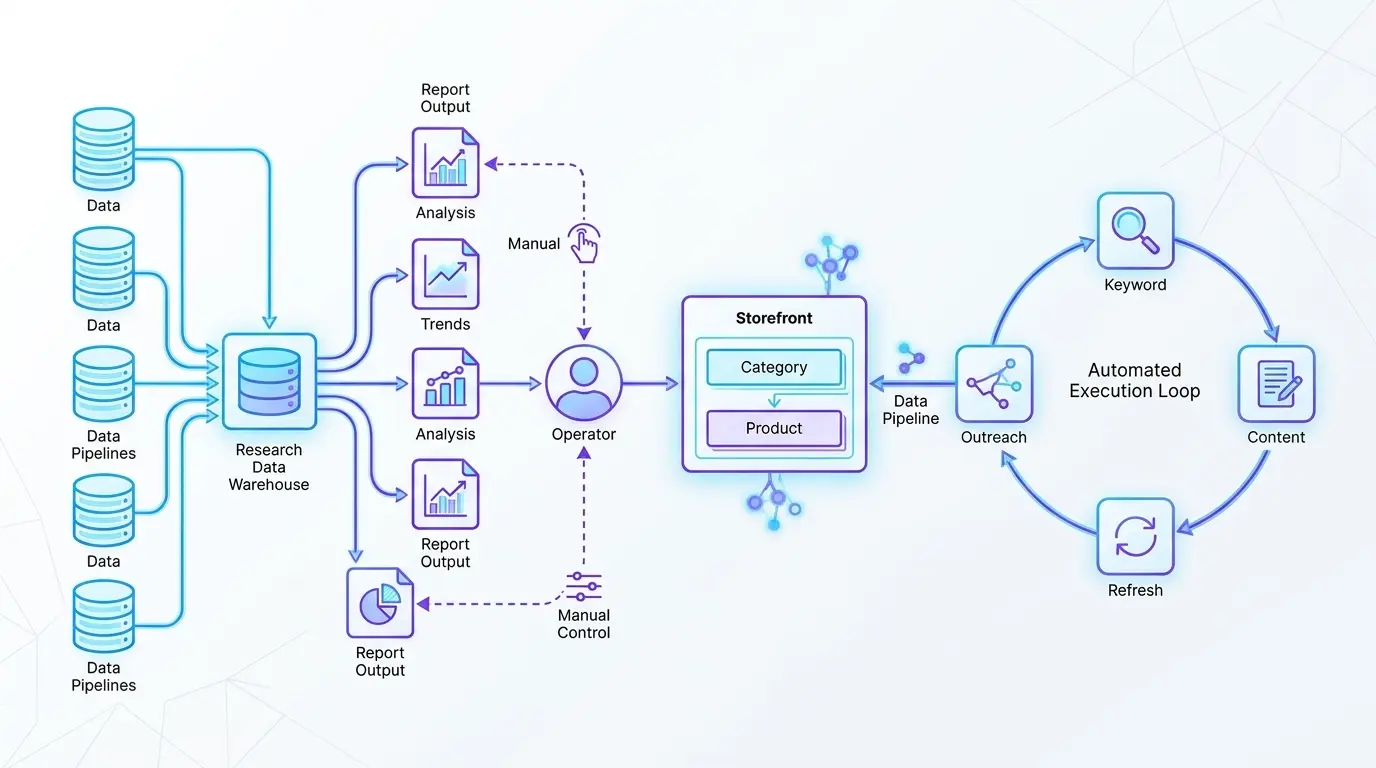
Semrush is the broadest SEO research suite available: keyword databases across many countries, a large backlink index, competitor and market data, and reporting that agencies have standardized on for years. Scalnex is an AI SEO platform built to execute: it runs the keyword-to-content-to-refresh-to-outreach loop as autonomous agents and publishes the results. For an e-commerce brand, the question is not which has more data. It is whether you have a person to turn data into work every week. If you do, Semrush gives that person more to work with. If you do not, Scalnex does the work.
TL;DR
- Semrush wins on research breadth, data history, multi-country keyword coverage and mature reporting. It is the better choice when an SEO specialist or agency will use it daily.
- Scalnex wins on execution: category and product-page tracking that creates refresh tasks, article generation with a brand kit, WordPress publishing and automated outreach, with a human approving rather than operating.
- For e-commerce specifically, the gap shows in what happens after a category page slips: Semrush reports it; Scalnex diagnoses it and queues the fix.
- Many stores run both: Semrush for research and reporting, Scalnex for the recurring jobs. Pricing models differ (per-seat tiers versus a platform pilot), so the combination is not cheap.
Not sure what to fix first? Send us your website and we'll email what we'd fix first within 24 hours. Run a free SEO audit →
Semrush is the research standard; Scalnex is built to execute the loop
Semrush's strength is breadth. Keyword Magic Tool covers very large keyword databases per country, including India. Position Tracking handles location- and device-level tracking with tags and share of voice. Backlink Analytics, Site Audit, Market Explorer and the Content Toolkit round out a suite where almost any SEO question has a module, and its reporting and Looker Studio integration are what agencies and in-house teams already expect.
What Semrush does not do is run the next step. It will show you that your "cotton kurta sets" category page fell from 5 to 11 and that two competitors refreshed theirs; a person then writes the brief, assigns the rewrite, publishes it and checks back. The suite is an instrument panel for a pilot.
Scalnex starts from the opposite assumption: there is no pilot, or the pilot has three other jobs. Its agents cluster keywords and pick targets, generate or optimize content against a brand kit, publish through a WordPress plugin, track rankings daily, raise alerts with a probable cause, create refresh tasks when pages decay, run a technical audit and send guest-post outreach. A human sets strategy and approves; the platform executes. Its research data is scoped to what the agents need, so an analyst will find it narrower than Semrush. How its outreach compares with dedicated tools is covered in our automated link building guide.
That is the honest shape of the automated SEO vs Semrush debate: one is a wider toolkit; the other is a smaller toolkit that holds the tools itself.
Ten capabilities side by side
| Capability | Semrush | Scalnex |
|---|---|---|
| Keyword research depth | Very large multi-country databases, intent labels, long history | Autonomous clustering focused on your categories and products; narrower general database |
| Competitor analysis | Keyword gap, backlink gap, Market Explorer, traffic estimates | Identifies real SERP competitors per cluster; gaps become briefs and outreach prospects |
| Rank tracking | Daily, location and device level, tags, share of voice, SERP features | Daily, tagged by category and page type, alerts with probable cause |
| Content creation | Content Toolkit: briefs, SEO Writing Assistant, AI drafting as an add-on | Article generation and optimization with a brand kit, as a core agent |
| Content refresh | Audit flags decaying pages; refresh is manual | Decay detected by tracking and queued as a refresh task automatically |
| Publishing to CMS | WordPress plugin for the writing assistant; publishing largely manual | WordPress plugin publishes and updates posts from the platform |
| Technical SEO audit | Mature Site Audit with scheduled crawls and issue grouping | Site audit plus a free public audit page; issues feed task list |
| Link building | Link Building Tool for prospecting and outreach management | Automated guest-post and backlink outreach agent, with tracking of links earned |
| Reporting | Extensive templates, white-label, Looker Studio connector | Daily and monthly reviews that pair rank changes with tasks completed; exports |
| Pricing model | Per-seat subscription tiers; limits on projects, keywords and reports per tier; add-ons for extra modules | Platform subscription sold through paid pilots; scoped by sites and agents rather than seats |
A fair reading of the table: Semrush has the deeper or more mature entry in six of the ten rows. Scalnex's advantage is concentrated in the rows about doing (refresh, publishing, outreach execution, task creation), and those rows are where e-commerce teams lose the most time.
Where e-commerce makes the difference visible
A D2C store with 800 SKUs across 40 categories has an SEO surface most generic comparisons ignore. Three parts of it decide which tool fits.
Category tracking at the page-type level
Revenue concentrates in category pages, not individual products. Semrush's Position Tracking tags keywords by category and shows share of voice per tag. Scalnex treats the category page itself as the unit: when the cluster's average slips, the alert names the page and the likely cause (competitor refresh, SERP feature change, canonical issue). For how to pick the 300 keywords worth tracking in a 2,000-SKU store, see the rank tracker guide for e-commerce websites.
Product-page and category-copy refreshes
Category copy, buying guides and comparison posts decay as competitors update theirs and search intent drifts. In Semrush, you find decay in the Content Audit or Position Tracking, then write and publish a refresh by hand. In Scalnex, decay triggers a refresh task; the content agent rewrites against the brand kit and the ranking competitors, and the plugin pushes it live after approval. For a store with 40 categories and no content team, that is the difference between refreshes happening and refreshes being planned.
Publishing: WordPress and Shopify
If your blog and guides run on WordPress (common for Indian D2C brands that pair Shopify for the store with WordPress for content), Scalnex publishes directly. For Shopify storefront pages, both tools stop at the draft and copy is pasted into the Shopify admin. Semrush's WordPress integration serves its writing assistant rather than publishing from the suite. Neither tool edits Shopify product descriptions in place. See e-commerce SEO for the current publishing surfaces.
Pick Semrush if you have the operator
Choose Semrush when an SEO specialist, a marketing lead with real weekly SEO time, or an agency will be in the tool; the breadth repays an operator who knows what to look for. Choose it when you sell in several countries and need deep keyword data per market, when paid search, PR and social data in one place matter, and when reporting must match what an agency or board already expects. It is also the stronger pick for research-heavy work (new market entry, large catalog expansion) rather than maintenance.
Pick Scalnex if nobody owns SEO
Choose Scalnex when the honest answer to "who checks rankings every week" is "nobody" or "the founder, sometimes." The value is in the recurring jobs that otherwise do not happen: daily tracking that produces tasks, category copy that gets refreshed, articles that get published, outreach that gets sent. It is a serious Semrush alternative for e-commerce brands in India and elsewhere with a catalog, a WordPress blog and no SEO hire, and a weaker fit for teams whose main need is exploring data by hand. The full list of agents is on the features page.
Use both if you can afford the overlap
Agencies and larger D2C teams often keep Semrush for research, competitive intelligence and client-facing reporting, and run the platform for execution: tracking tied to tasks, refreshes, publishing and outreach. The overlap is in rank tracking and site audit; pick one as the system of record for positions so two tools do not disagree in the same meeting. If a tracker is the decision, the rank tracker software comparison lays both against Ahrefs, SE Ranking and AccuRanker on the same criteria.
FAQ
Is Scalnex a Semrush alternative?
For execution, yes: it covers keyword research, tracking, content, audit and outreach and then runs those jobs as agents. For research depth and multi-country data, Semrush remains broader. Brands replacing Semrush with Scalnex usually do so because the suite was being paid for and not used.
Can I use Scalnex with Semrush?
Yes. A common split is Semrush for research and reporting, Scalnex for recurring execution. Choose one tool as the source of truth for rank positions, and export Semrush keyword lists into Scalnex clusters rather than researching twice.
Which is better for e-commerce in India?
Semrush has a large India keyword database and is the better research tool for the market. Scalnex is the better fit when the store has no SEO specialist and needs category tracking, refreshes and publishing done rather than reported. Many Indian D2C brands fall into the second group.
Does Scalnex have Semrush's data?
No. Scalnex's research is scoped to the clusters and competitors relevant to your site, and it identifies competitors from live SERPs. It does not offer a general-purpose keyword database to browse. If exploring data at that scale is the job, Semrush is the tool.
The quickest way to decide is to compare what each tool does with one real problem. Book a demo and bring your most important category page: the team will show its keyword cluster tracked, the alert and diagnosis it would produce on a drop, the refresh task the content agent generates, and how it publishes to your WordPress blog. If you also run Semrush, bring the same page's Position Tracking report and compare what each hands back to you.