Getting alerts when rankings drop: thresholds that stay useful and what to check first
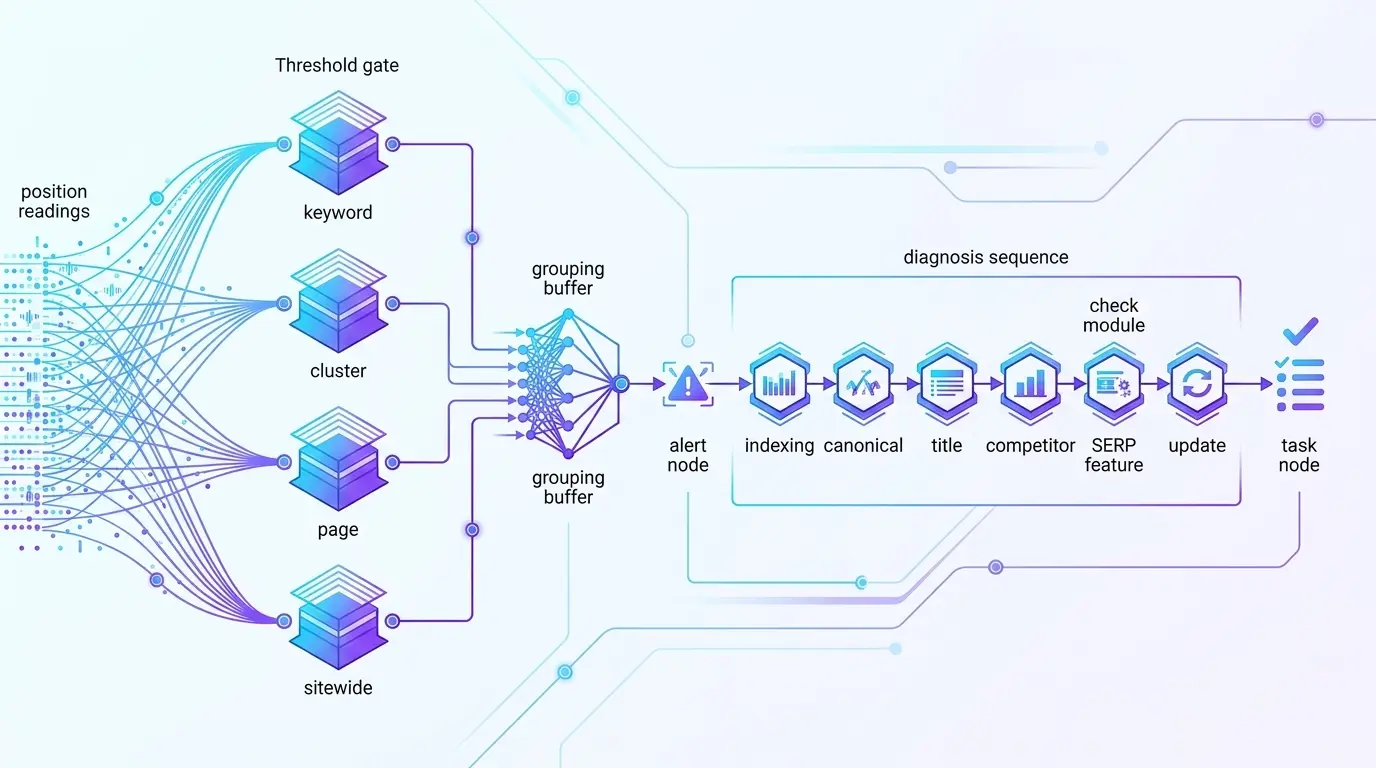
Alerts when rankings drop are only useful if the threshold matches the kind of drop. A single keyword slipping three places is noise; a product category losing ten places across its cluster is a revenue problem; a sitewide slide during a Google update is a different investigation. Set one rule for each of the four drop types, group alerts so one event produces one notification, and follow a fixed 30-minute checklist when an alert fires.
TL;DR
- Four kinds of drop (single keyword, cluster, page, sitewide) need four thresholds. One global "alert on -3" rule creates fatigue and misses the drops that matter.
- Alert tightly on revenue pages and head terms, loosely on long-tail, and require the drop to persist for two daily checks before notifying.
- First 30 minutes after an alert: indexing, canonical, title or content change, competitor's new page, SERP feature shift, Google update rollout.
- A tracker that turns the alert into a diagnosis and a task removes the step where someone copies the keyword into a spreadsheet and forgets it.
Get drop alerts on your own site. Book a 30-minute demo and see daily rank tracking with drop alerts set up for your top keywords. Book a demo →
The four kinds of drop need four different thresholds
Rank movement is normal. Google tests result orders, personalizes by location and shows different layouts by device. A rank drop alert that fires on any movement trains you to ignore it within a week. Set a threshold per type.
Single keyword: alert when it crosses a click cliff
A keyword moving from 4 to 6 loses clicks; one moving from 14 to 16 loses almost none. Alert when a keyword drops out of the top 3, top 10 or top 20, and ignore movement inside those bands. For your twenty most valuable queries, add an absolute rule: a drop of 5 or more places that holds for two consecutive days.
Cluster: alert on the group's average, not one member
Group keywords by intent and category: "linen shirts for men", "men's linen shirt india" and "best linen shirts" all point at one category page and form one cluster. Alert when the cluster's average position falls by 3 or more, or when the share of its keywords in the top 10 falls by a fifth. A cluster alert almost always means something happened to the page or its competitors.
Page: alert on the URL, not the keyword
Most trackers organize by keyword; most problems happen to pages. Alert when a page's count of top-20 keywords falls by a quarter week over week. A revenue category page gets the tight rule; a two-year-old blog post gets a loose one or none.
Sitewide: alert on breadth, then check for an update
If more than a fifth of tracked keywords drop on the same day, the cause is rarely one page. It is a technical issue (a deploy that added noindex, broke canonicals or slowed the site), a manual action, or a Google core or spam update. Alert on the proportion of keywords moving down, not on average position.
Alert fatigue comes from thresholds and grouping, not from tracking too much
Teams that abandon SEO monitoring alerts usually made three fixable mistakes.
They alerted on a single day's reading. Daily trackers sample one SERP at one time from one location, and any reading can be an outlier. Requiring two consecutive readings removes most false positives at the cost of a day's delay.
They sent one notification per keyword. Fifty keywords on one page dropping together is one event. A good keyword ranking alert tool groups by page and cluster, so the notification reads "Category: linen shirts, 23 keywords down, avg -6" rather than 23 messages.
They treated all keywords equally. Tag by value: revenue pages, head terms, brand, long-tail. Tight thresholds on the first two, loose on the rest. A long-tail drop from 18 to 24 belongs in a weekly digest, not a Slack ping.
For how alerts fit a weekly operating rhythm, see how to turn rank tracking data into organic growth.
What to check in the first 30 minutes after an alert
Resist the urge to rewrite the page. Most drops have a findable cause, and the fix is often not editorial. Work through these in order.
1. Is the page still indexed? (5 min) Run URL Inspection in Google Search Console. "Excluded", "crawled, currently not indexed" or blocked by robots is your answer; check whether a recent deploy added noindex or changed robots.txt.
2. Did the canonical change? (3 min) If the Google-selected canonical points to a parameter URL, a staging domain or a near-duplicate product page, the ranking has been consolidated elsewhere. Faceted e-commerce navigation causes this constantly.
3. Did the title, H1 or body change? (5 min) Check CMS revision history and the Wayback Machine. A renamed category, a theme update truncating titles or a plugin rewriting meta tags can move positions within days.
4. Did a competitor publish or refresh? (7 min) Open the SERP for the cluster's main keyword. A new or freshly dated page where you were means a refresh is the response. A marketplace or publisher moving in means the SERP's intent may be shifting from purchase to comparison.
5. Did the SERP layout change? (5 min) Count what sits above the first organic result: Shopping units, AI Overview, People Also Ask, video, local pack. A page can hold position 4 and lose a third of its clicks because an AI Overview appeared.
6. Is a Google update rolling out? (5 min) Check Google's Search Status Dashboard. If an update is live and your drop is broad, wait for the rollout to finish before changing anything.
Write the finding and decision into the alert record ("competitor refreshed, schedule rewrite"). It takes ten seconds and is the fastest answer when a founder asks "why did my rankings drop" on a Monday.
How Scalnex turns an alert into a diagnosis and a task
Scalnex's rank tracking checks positions daily and applies the threshold logic above by tag, cluster and page. When an alert fires, the platform runs the first-30-minutes checks itself: indexing status from Search Console, canonical, on-page changes against the last crawl, SERP-feature changes from its daily snapshot, and whether a competitor URL has entered the top results. It attaches the probable cause to the alert.
Then it creates the task: a content-driven drop becomes a refresh task for the content agent with the competing page as reference, a technical drop becomes an audit item, a SERP-feature loss is flagged for a format change. A human approves; nothing waits on someone opening a spreadsheet. Among the trackers in the rank tracker software guide, that execution step is what is left to compare once daily tracking and alerting are table stakes.
FAQ
What is a good position-change threshold for a rank drop alert?
Tie it to click cliffs rather than a fixed number: alert when a keyword leaves the top 3, top 10 or top 20, and add an absolute rule of 5 or more places for your most valuable terms. Require the drop to hold for two consecutive daily checks before notifying.
Why did my rankings drop suddenly across the whole site?
A broad same-day drop usually points to a technical change (noindex, canonical, robots, a slow deploy), a manual action, or a Google update in progress. Check Search Console coverage and the Search Status Dashboard first; do not edit content until the cause is clear.
Is there a free SEO alert tool for ranking drops?
Google Search Console emails about coverage and manual-action problems but does not alert on position changes. A free workaround is a scheduled Looker Studio or Sheets report from Search Console data. Position-based alerts with thresholds and grouping need a paid tracker.
How often should rank alerts check positions?
Daily is the standard that makes alerts meaningful; weekly checks catch drops after a week of lost traffic. Hourly tracking adds noise for most sites. Daily sampling with a two-day confirmation rule is the balance between speed and false positives.
If your current tracker tells you a keyword fell and leaves the rest to you, see what it looks like when the diagnosis and the task are generated for you. Book a Scalnex demo with your most important category page and its keyword cluster: the team will set alert thresholds for it live and walk through the refresh task a drop produces.