How to Optimize for Google and ChatGPT Search With One Content System
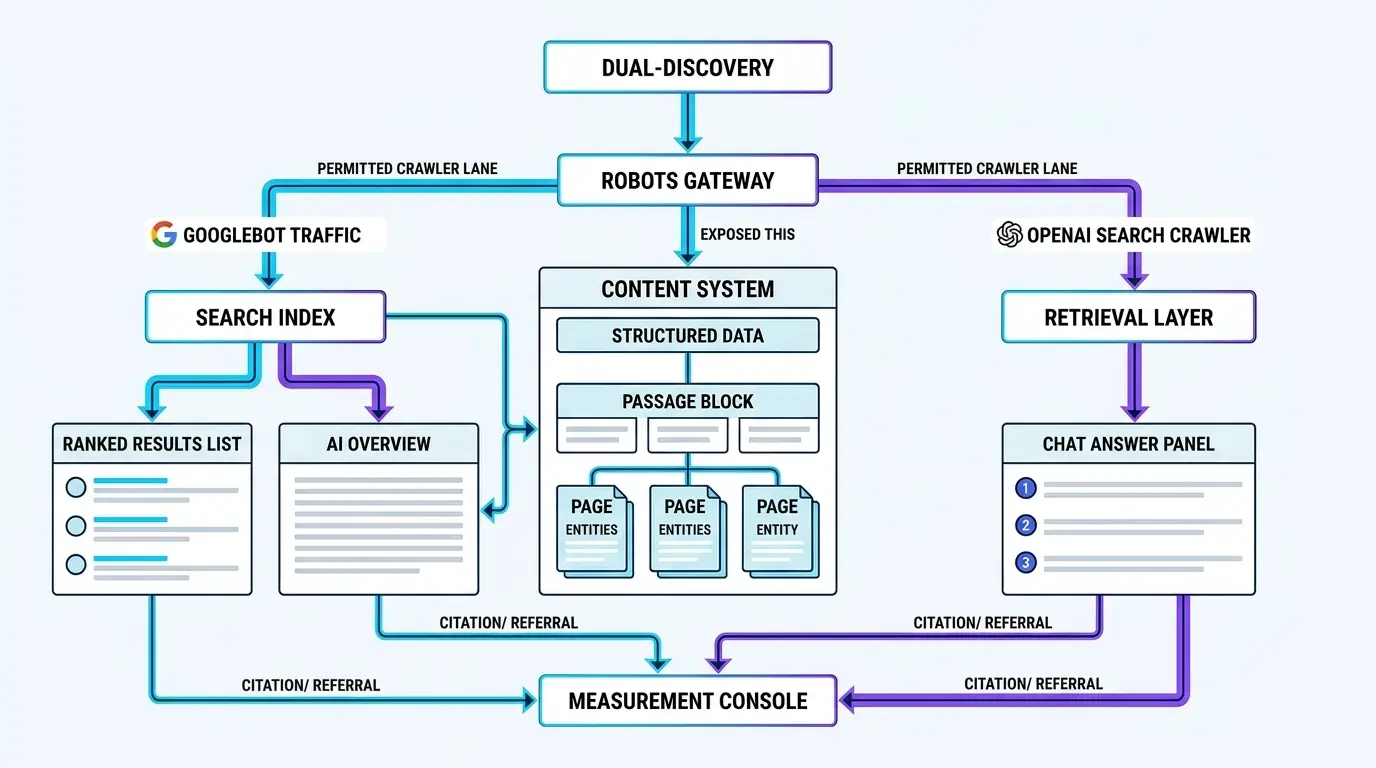
To optimize for both Google and ChatGPT search, build one content system that both can crawl, parse and cite: open crawler access, entity-clear pages, passage-complete answers, accurate structured data and first-party specifics competitors cannot copy. The two engines retrieve differently, but they reward the same underlying properties, so you do not need separate strategies. Search has become dual discovery, with buyers moving between a results page and a chat answer, and a single retrieval-ready architecture serves both.
TL;DR
- Allow the right crawlers: Googlebot for Google, and OAI-SearchBot for ChatGPT search results. GPTBot is a separate, training-related decision.
- Write pages where every section answers one question completely in its first sentences, with named entities and specific facts.
- Keep structured data accurate and matched to visible content; publish comparisons and first-party specifics worth citing.
- Measure each engine separately: Search Console and rank tracking for Google, prompt-based citation checks and referral data for ChatGPT.
Not sure what to fix first? Send us your website and we'll email what we'd fix first within 24 hours. Run a free SEO audit →
Crawl Access Is the Gate for Both Engines
No optimization matters if the crawler is blocked. The two ecosystems use different user agents, and they control different things.
- Googlebot crawls for Google Search, and Google's AI features such as AI Overviews and AI Mode draw on the same index. Blocking Googlebot removes you from both.
- Google-Extended is a separate robots token that governs use of content for Gemini model training and grounding. It is not a Search ranking signal and does not control inclusion in AI Overviews.
- OAI-SearchBot is the crawler OpenAI documents for surfacing sites in ChatGPT search results. If you want to appear and be linked there, allow it.
- GPTBot is OpenAI's crawler for content that may be used to train models. Allowing or blocking it is a policy choice separate from search visibility.
- ChatGPT-User covers fetches a user's request triggers in real time.
Our own site allows OAI-SearchBot and GPTBot. Whatever you decide, check robots.txt, firewall and bot-protection rules together; a CDN rule that challenges unknown bots can silently block a crawler your robots file allows. OpenAI has also said ChatGPT search uses third-party search providers alongside its own crawling, so confirm your pages are indexed in Bing Webmaster Tools as well as Google Search Console.
Entity-Clear Pages Give Both Systems Something to Resolve
Google and ChatGPT both need to know precisely what a page is about before they cite it. Pages that name entities, meaning your brand, product, category, integrations and competitors, give retrieval and synthesis clean anchors.
- State what your company and product are in plain language on the homepage and About page.
- Use the same names for products and features everywhere, including third-party profiles.
- Name the subject in each section rather than relying on pronouns carried over from earlier paragraphs.
- Describe relationships explicitly: "integrates with," "alternative to," "designed for."
Entity trust builds when your own pages and the sources that mention you describe you consistently.
Passage-Complete Answers Win Retrieval on Both Surfaces
Google's AI features use query fan-out, splitting a query into sub-queries and retrieving passages for each. ChatGPT search also retrieves web results and composes an answer from them. In both cases, a passage that answers its question without needing the rest of the page is easier to extract and cite. The retrieval mechanics are compared in query fan-out vs semantic search.
Write each section to this pattern:
- A heading that states the sub-question or claim.
- A first sentence that answers it directly.
- Two to four sentences of specific support: numbers you own, steps, constraints, conditions.
- A table or list where the content is comparative or sequential.
This structure also suits featured snippets in classic Google results, so it costs nothing on the traditional side.
Structured Data and First-Party Specifics Make You Citation-Worthy
Structured data helps Google understand page type and eligibility for rich results; keep it accurate, valid and identical in substance to the visible page. Organization, Product or SoftwareApplication, Article, and FAQPage markup cover most commercial sites. No LLM publishes its ranking factors, so treat schema as clarity infrastructure, not a guaranteed lever for ChatGPT.
What reliably earns citations on both surfaces is information no one else has:
- Your actual specifications, supported integrations, limits and setup steps.
- Original data from your own product or operations, presented with its method.
- Fair comparisons that state where an alternative fits better.
- Clear definitions in your category that other sources lack.
Generic summaries of public information compete with thousands of identical pages. Specifics give the synthesis a reason to choose you.
One Checklist, Two Engines
| Action | Google effect | ChatGPT search effect |
|---|---|---|
| Allow Googlebot; check rendering | Required for indexing, rankings and AI Overviews | Indirect: supports the wider index ecosystem |
| Allow OAI-SearchBot | None | Required to be surfaced and linked in results |
| Confirm Bing indexation | None | Supports discovery through third-party search providers |
| Entity-clear naming and About page | Helps entity understanding | Helps the model identify and describe you accurately |
| Answer-first, self-contained sections | Snippet eligibility; passage retrieval for AI features | Easier extraction and citation |
| Accurate structured data | Rich results eligibility; page understanding | Clarifies page type and facts; no documented ranking role |
| First-party specifics and original data | Helpfulness and link earning | Distinctive content worth citing |
| Fair comparison tables | Matches comparison intent | Maps onto comparison sub-queries |
| Consistent third-party profiles | Supports reputation and entity signals | Cross-source consistency for synthesis |
Measure Presence in Each Engine Separately
Google and ChatGPT expose different data, so one dashboard will mislead you.
Google. Search Console reports clicks, impressions and average position, and Google counts AI Overviews and AI Mode activity within Search totals rather than as a separate report. Pair it with keyword tracking to watch daily positions and spot drops, and check AI Overview presence manually for priority queries.
ChatGPT. There is no equivalent of Search Console. Define 20 to 40 buyer prompts, run them on a schedule, and record which domains are cited and whether your pages appear. In analytics, segment referral traffic from chatgpt.com; ChatGPT commonly appends a utm_source parameter to outbound links, which makes the segment easier to isolate. Answers vary between runs, so track trends rather than single results.
Legacy diagnostic suites cover the Google side well, but their implementation bottleneck is that they stop at reporting. The fixes, such as rewriting passages, filling sub-intent gaps and rechecking citations, still land on your team. AI agents that perform autonomous execution close that gap; Scalnex runs content optimization, daily rank tracking with alerts and technical audits as one loop. The strategic framing is in traditional SEO vs generative engine optimization.
FAQ
How do I rank in ChatGPT search?
Allow OAI-SearchBot, make sure your pages are indexed, including in Bing, and write self-contained sections that answer specific questions with named entities and first-party facts. OpenAI does not publish ranking factors, so focus on being crawlable, clear and worth citing, then measure with repeated prompt checks.
Should I block GPTBot to protect my content?
That is a policy decision about model training, separate from search visibility. Blocking GPTBot does not remove you from ChatGPT search results as long as OAI-SearchBot is allowed. Decide based on how you want your content used, and document the choice in robots.txt.
Is ChatGPT SEO different from Google SEO?
The foundations are the same: crawl access, clear content, authority and useful specifics. The differences are crawler rules, the absence of a Search Console equivalent, and an output that cites sources inside an answer rather than listing links. One content system can serve both.
How do I know if AI search optimization is working?
Track a fixed prompt set across Google AI features and ChatGPT search, logging citations over time. Watch AI referral traffic in analytics and Search Console trends for the same pages. Improvement shows as more prompts citing you and more sub-intents covered, measured across repeated runs.
The operational verdict: running separate Google and ChatGPT playbooks through legacy diagnostic workflows doubles the effort and still leaves the execution backlog untouched. One retrieval-ready content system, maintained by autonomous SEO infrastructure, serves dual discovery at the cost of one. Check your crawl access, entity clarity and passage structure first. Run a free SEO audit — no credit card required.