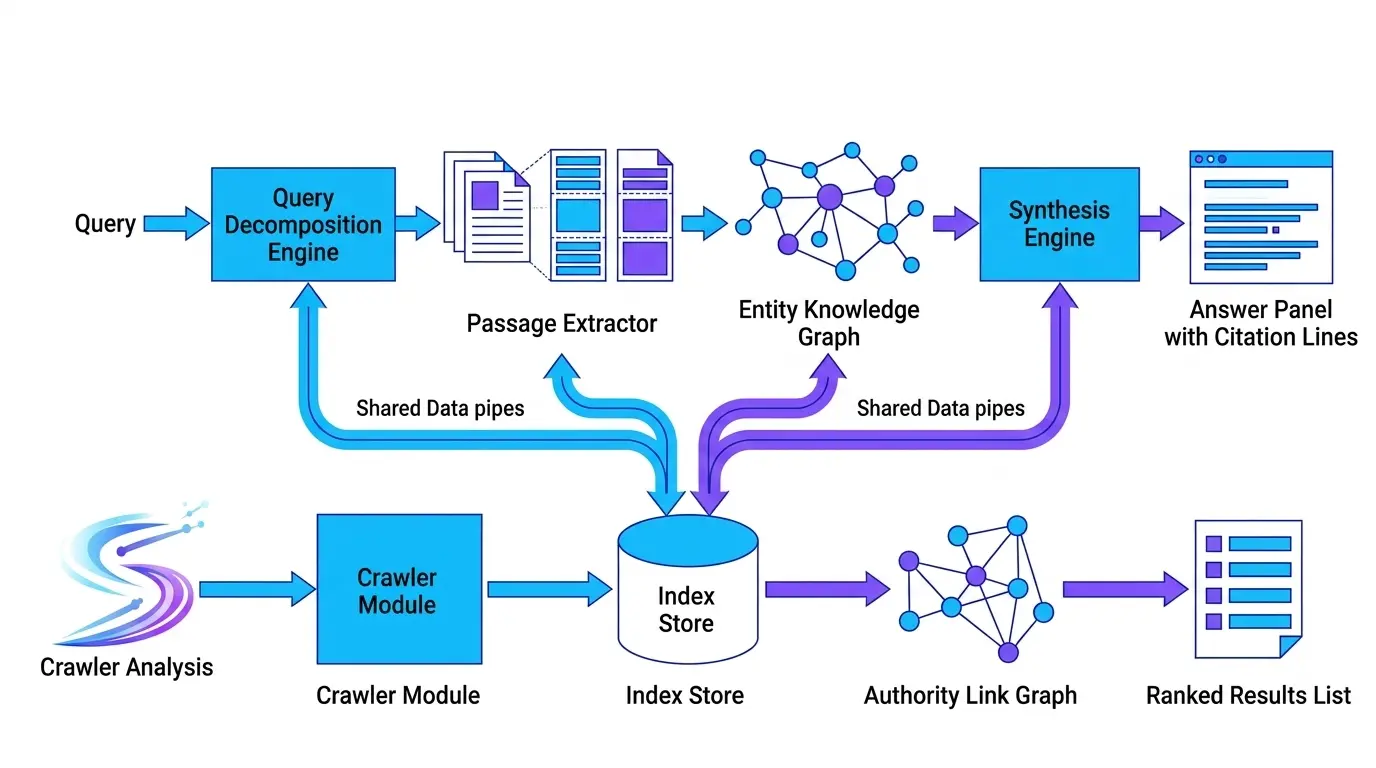
Traditional SEO vs Generative Engine Optimization: What Carries Over and What Changes
Traditional SEO optimizes whole pages to rank in a list of links; generative engine optimization (GEO) optimizes passages and entities to be retrieved, trusted and cited inside AI-generated answers. GEO does not replace SEO: crawlability, authority and genuinely useful content still decide whether you enter the index that AI systems retrieve from. What changes is the unit of competition, the signal of success and the way you measure it. Treat GEO as a new layer on a foundation you cannot skip.
TL;DR
- Crawl access, indexation, authority and helpful content carry over unchanged; without them, GEO has nothing to work with.
- GEO shifts the focus from pages to passages, from keywords to entities, and from clicks to citations.
- Measurement changes most: rank positions describe classic results, while AI visibility requires tracking citations across prompts.
- The cost of ignoring the new layer is invisibility in answers your buyers increasingly read first.
Not sure what to fix first? Send us your website and we'll email what we'd fix first within 24 hours. Run a free SEO audit →
Generative Engine Optimization Optimizes for Retrieval and Synthesis
Generative engine optimization is the practice of structuring content so AI systems, including Google AI Overviews and AI Mode, ChatGPT search and Perplexity, retrieve it, judge it reliable and cite it in a synthesized answer. These systems commonly use query fan-out: one prompt becomes many sub-queries, each retrieves candidate passages, and a model composes the answer from the best of them. The mechanics are covered in what query fan-out is.
Traditional SEO targets a different output. A search engine scores documents against one query and returns a ranked list, and your job is to earn a high position and a click.
The Foundation Carries Over Unchanged
AI search systems do not crawl a separate web. They retrieve from indexes that depend on the same fundamentals SEO has always addressed.
- Crawlability and indexation. A page blocked by robots rules, buried behind JavaScript that does not render, or missing from the index cannot be retrieved by any system.
- Authority. Links and reputation still shape which sources a system treats as credible. A new domain with no references is a weak citation candidate, which is why earning links through outreach still matters in a GEO strategy.
- Helpful, original content. Google's guidance on people-first content applies to AI features as well. Thin, derivative pages are poor retrieval candidates in every model.
- Page experience and technical health. Fast, stable, accessible pages are easier to fetch and parse.
If your technical base is weak, GEO tactics produce nothing. Fix the foundation first.
Eight Dimensions Where SEO and GEO Diverge
| Dimension | Traditional SEO | Generative engine optimization |
|---|---|---|
| Unit of competition | Whole page | Individual passage |
| Query model | One query, one ranked list | One prompt fanned into many sub-queries |
| Relevance signal | Keyword and topical match to the query | Semantic match per sub-intent, plus extractability |
| Trust signal | Links and domain authority | Authority plus entity trust and cross-source consistency |
| Content structure | Comprehensive pages targeting a keyword | Self-contained, answer-first sections per sub-intent |
| Success outcome | Position and click-through | Citation and mention inside the answer |
| Measurement | Rank tracking and Search Console | Citation tracking across prompts and engines, plus AI referral traffic |
| Discovery surface | Google results pages | Google and AI assistants such as ChatGPT: dual discovery |
Passages Replace Pages as the Competitive Unit
In a ranked list, a long page that covers a topic thoroughly can win even if its best answer is buried in the middle. Under fan-out retrieval, the system scores passages. A buried answer that depends on earlier context loses to a shorter, self-contained passage on a weaker site.
The fix is structural: one sub-intent per heading, the direct answer in the first sentence, the subject named explicitly, and specific supporting facts. This does not conflict with traditional SEO. Clear structure has always helped featured snippets; GEO raises it from good practice to a requirement.
Entity Trust Replaces Keyword Matching as the Core Relevance Layer
Traditional SEO trained teams to think in strings. Generative systems think in entities: your brand, your products, their categories, the problems they solve and the companies you compete with. These systems increasingly resolve content against structured knowledge, so a brand that is described consistently across its own site and third-party sources is easier to cite with confidence.
Practical entity work includes consistent naming, an About page that states what you are, Organization and product schema that matches visible content, and accurate profiles on the third-party sites your category relies on. Vector knowledge graphs are a useful mental model: your content should place your brand in a clear, stable position relative to the concepts buyers search for.
Citations Replace Clicks as the Success Signal
An AI answer may satisfy the user without a click. That makes citation presence the primary GEO outcome: being named and linked as a source in the answer. Clicks still matter, and cited sources do receive referral traffic, but a strategy measured only by sessions will undercount its own visibility.
This is where legacy diagnostic suites run out of road. Semrush and Ahrefs are strong databases for keyword volumes, backlinks and rank history, and they remain worth using for the classic layer; our roundup of SEO tools covers where each fits. Their implementation bottleneck is passive reporting: they describe positions for queries you specify and leave every rewrite, publish and recheck to you. GEO adds sub-queries no one tracks and passage-level fixes no dashboard performs.
Running Both Layers as One System
You do not need two teams or two content calendars. Run one pipeline with two sets of checks.
- Technical foundation. Crawl access, indexation, rendering, speed, structured data. Shared by both layers.
- Coverage. Map prompts to sub-intents, and sub-intents to pages. This replaces the flat keyword list. The SaaS version is detailed in query fan-out SEO for SaaS.
- Structure. Answer-first, self-contained sections with explicit entities. Helps snippets and AI retrieval alike.
- Authority. Earn references and keep entity descriptions consistent off-site.
- Measurement. Track positions for classic results and citations for your prompt set, side by side.
The volume of work in steps two through five is the real constraint. AI agents that perform autonomous execution, generating the sub-query map, rewriting weak passages, publishing and rechecking, are how a small team runs both layers without doubling headcount. Scalnex's platform features are built around that execution model.
FAQ
What is generative engine optimization?
Generative engine optimization is the practice of structuring content so AI systems such as Google AI Overviews, AI Mode, ChatGPT search and Perplexity retrieve it, trust it and cite it in their answers. It focuses on passage-level clarity, sub-intent coverage, entity consistency and citation measurement.
SEO vs GEO: which should I prioritize?
Prioritize the SEO foundation first, because AI systems retrieve from indexes that depend on crawlability, authority and quality. Then add the GEO layer: passage structure, entity clarity and citation tracking. Treating them as competing priorities misreads how the systems work; GEO depends on SEO.
Does GEO replace traditional SEO?
No. Classic results still drive substantial traffic, and AI answers draw on the same indexed web. GEO changes what you optimize at the passage and entity level and how you measure success, but it rests on the same technical and authority foundation SEO has always required.
How do you measure GEO results?
Define a set of buyer prompts, run them regularly across Google AI features, ChatGPT search and Perplexity, and record which sources are cited. Track branch coverage across sub-intents and segment AI referral traffic in analytics. Treat individual runs as samples, since answers vary.
The operational verdict on GEO vs SEO: keeping a legacy diagnostic workflow and bolting GEO on as a manual side project doubles the operational friction without doubling the output. The teams that keep up treat both layers as one pipeline and move the repetitive execution to autonomous SEO infrastructure. Find out where your foundation and passages stand today. Run a free SEO audit — no credit card required.