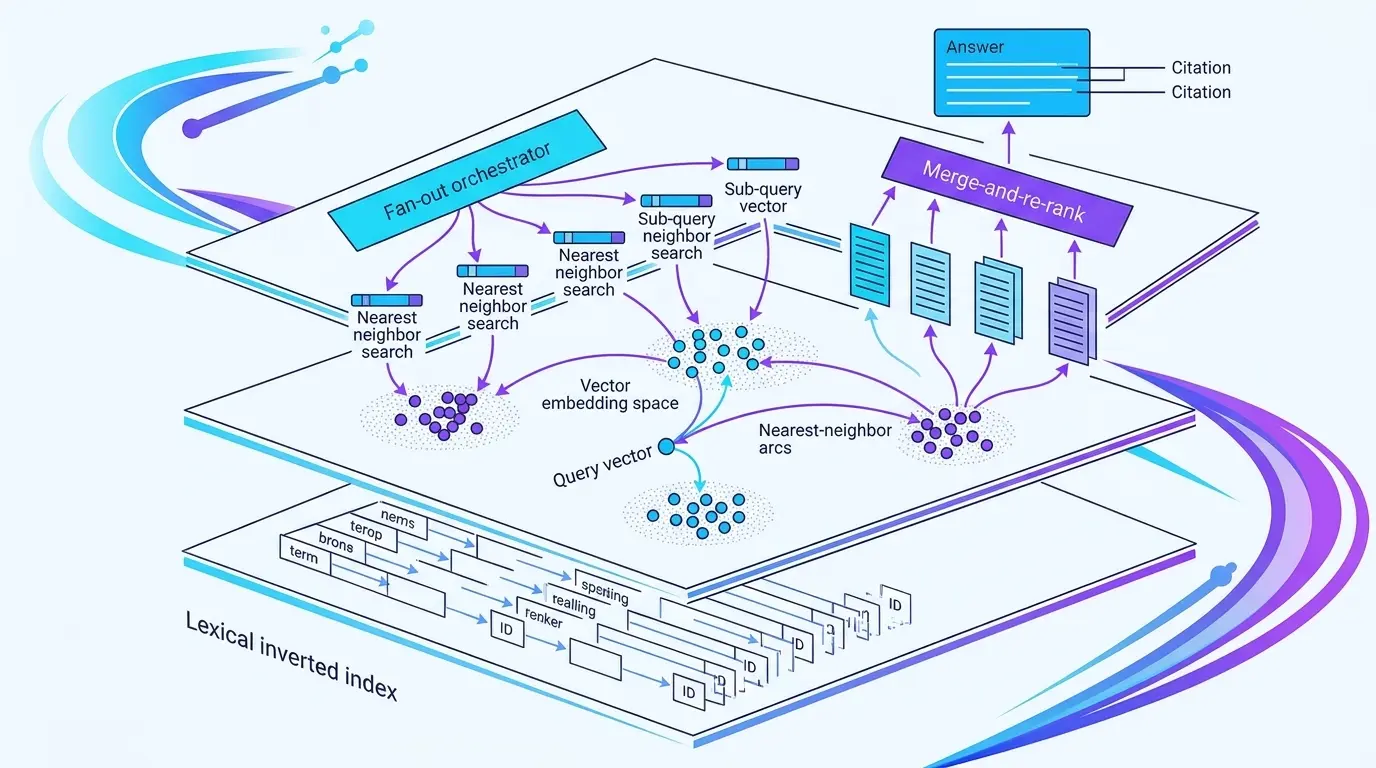
Query Fan-Out vs Semantic Search: How Three Retrieval Models Rank Your Content
Query fan-out and semantic search are not competitors; fan-out is built on top of semantic search. Semantic search retrieves documents whose meaning matches one query using embeddings and vector similarity, while query fan-out expands that query into many sub-queries, runs a semantic retrieval for each, then re-ranks and synthesizes the results. The architectural shift runs from matching strings, to matching meaning, to assembling answers, and each layer changes what your content must do to be retrieved.
TL;DR
- Lexical search matches terms, semantic search matches meaning in vector space, and fan-out runs many semantic retrievals in parallel before synthesis.
- Semantic search rewards topical precision; fan-out additionally rewards breadth of sub-intent coverage and passages that stand alone.
- Query expansion is the bridge: classic search used it to add synonyms, fan-out uses it to generate whole new questions.
- Content that wins under fan-out also wins under semantic search, but the reverse is not guaranteed.
Not sure what to fix first? Send us your website and we'll email what we'd fix first within 24 hours. Run a free SEO audit →
Three Retrieval Models Form One Stack, Not Three Alternatives
Most explanations frame these as rival technologies. In production systems they coexist. Lexical signals still matter for exact names and rare terms, semantic retrieval handles paraphrase and intent, and fan-out orchestrates both across many sub-queries.
Lexical Retrieval Matches Terms in an Inverted Index
Lexical search, typified by algorithms such as BM25, stores which documents contain which terms. A query is scored by term overlap, weighted by how rare each term is. It is fast and precise for exact strings like product names, error codes and model numbers. It fails on vocabulary mismatch: a page about "client billing" may score poorly for "invoicing" even though it answers the question.
Semantic Retrieval Matches Meaning in Vector Space
Semantic search converts queries and documents, or passages, into embeddings: dense numeric vectors where proximity represents similarity of meaning. Retrieval becomes a nearest-neighbor search. "Invoicing" and "client billing" land close together, so the vocabulary mismatch disappears. The trade-off is that embeddings blur exact distinctions, which is why hybrid systems combine vector and lexical scores.
Fan-Out Retrieval Runs Many Semantic Searches, Then Synthesizes
Query fan-out, which Google has publicly described for AI Mode and AI Overviews, adds an orchestration layer. A model decomposes the prompt into sub-queries, each sub-query triggers its own retrieval, and the resulting passages are re-ranked together before a model writes one answer with citations. The details are covered in what query fan-out is.
Query Expansion Is the Mechanism That Connects Them
Query expansion is old. Classic engines appended synonyms and stemmed variants to improve recall. Semantic search made much of that implicit, because the embedding already captures related meaning.
Fan-out pushes expansion further. Instead of adding words to one query, it generates entirely new queries: comparisons, follow-ups, constraints and adjacent questions the user did not type. A prompt about choosing a project management tool for a remote design team may expand into sub-queries on async collaboration features, file versioning, client access controls and alternatives to a named market leader. Each is a separate retrieval with its own competitive set.
The Three Models Compared on What They Reward
| Dimension | Lexical search | Semantic (vector) search | Query fan-out |
|---|---|---|---|
| Core mechanism | Term matching in an inverted index | Nearest-neighbor search over embeddings | Many sub-queries, parallel retrieval, re-ranking, synthesis |
| Handles synonyms | Only with explicit expansion | Natively | Natively, plus generated follow-up questions |
| Exact-match precision | High | Moderate | Inherited from the hybrid retrievers underneath |
| Unit retrieved | Document | Document or passage | Passage |
| Output | Ranked list | Ranked list | Synthesized answer with citations |
| Content it rewards | Presence of exact terms | Topical precision and clear meaning | Sub-intent breadth, self-contained passages, entity clarity |
| Main failure mode | Vocabulary mismatch | Blurred distinctions between close concepts | Missing sub-intents mean missing from the answer |
| Latency cost | Lowest | Moderate | Highest, offset by parallelism |
Where Semantic Search and Fan-Out Overlap
Both operate on meaning rather than strings. Both commonly work at passage level, scoring chunks of a page rather than the whole document. Both penalize content written around a single repeated phrase, because an embedding of a padded passage carries no more meaning than a concise one.
Practically, semantic search SEO and fan-out SEO share three requirements:
- Clear topical focus per passage. A section that wanders across topics produces an embedding that sits between clusters and matches nothing well.
- Natural vocabulary breadth. Use the terms a domain expert would use, including related entities and attributes, because they sharpen the passage's position in vector space.
- Precise entity naming. Embeddings encode named entities strongly; vague references weaken retrieval.
Where Fan-Out Demands More Than Semantic Search
Semantic search asks one question: is this passage close in meaning to this query? Fan-out asks that question dozens of times across sub-queries you did not choose, then asks a second question: is this passage good enough to cite in a synthesized answer?
That introduces three extra demands:
- Coverage across sub-intents. A page that perfectly matches the head query but ignores pricing models, integrations and alternatives is absent from most of the retrieval sets.
- Extraction-ready passages. Each passage must make sense alone, lead with its claim, and contain the specific facts a model can quote.
- Cross-source consistency. When several retrieved sources agree, the synthesis has more confidence. Claims that contradict your own other pages, or the consensus, weaken entity trust.
What This Means for Your Content Workflow
Keyword-centric workflows were built for lexical retrieval. Vector search vs keyword search is no longer the real decision; the decision is whether your workflow can produce passage-level coverage across an expanding set of sub-queries.
Legacy diagnostic suites still tell you volumes and positions for queries you specify, and keyword tracking remains the right baseline for classic results. The bottleneck is that the sub-queries driving AI answers are generated at runtime and rarely appear in a tracked keyword list. Closing that gap requires an execution layer: AI agents that generate the likely sub-query set, score each page's passages against it, and rewrite weak sections through content optimization. Scalnex runs that loop as autonomous execution rather than handing you another report to act on.
For the practical crawl, schema and measurement side across both engines, see how to optimize for Google and ChatGPT search.
FAQ
Is query fan-out the same as semantic search?
No. Semantic search retrieves results whose meaning matches a single query using embeddings. Query fan-out sits above it: it generates many sub-queries from one prompt, runs a retrieval for each, re-ranks the passages together and synthesizes an answer. Fan-out depends on semantic search but adds decomposition and synthesis.
What is the difference between vector search and keyword search?
Keyword search scores documents by shared terms, so it is precise for exact strings but misses paraphrases. Vector search compares embeddings, so it finds content with similar meaning even when wording differs, but it can blur close distinctions. Most modern engines combine both in hybrid retrieval.
How does query expansion affect SEO?
Expansion means the engine retrieves for queries you never targeted. Under classic search that meant synonyms; under fan-out it means comparisons, follow-ups and constraints. Your content must cover those adjacent sub-intents with clear sections, or it will not enter the retrieval sets that feed AI answers.
Does semantic search SEO still need keywords?
Yes, as vocabulary, not as density targets. Exact terms anchor lexical matching for names and specific phrases, and natural domain vocabulary sharpens a passage's embedding. Repeating one phrase adds nothing to meaning and does not help either retrieval model.
The operational verdict: optimizing for one retrieval model at a time is a legacy workflow, and its cost grows with every sub-query you fail to cover. Content built for fan-out satisfies semantic retrieval as a side effect, so build for the top of the stack and automate the passage audits that make it sustainable. Run a free SEO audit — no credit card required.