Query Fan-Out SEO for SaaS: A Retrieval-First Playbook for Marketing Teams
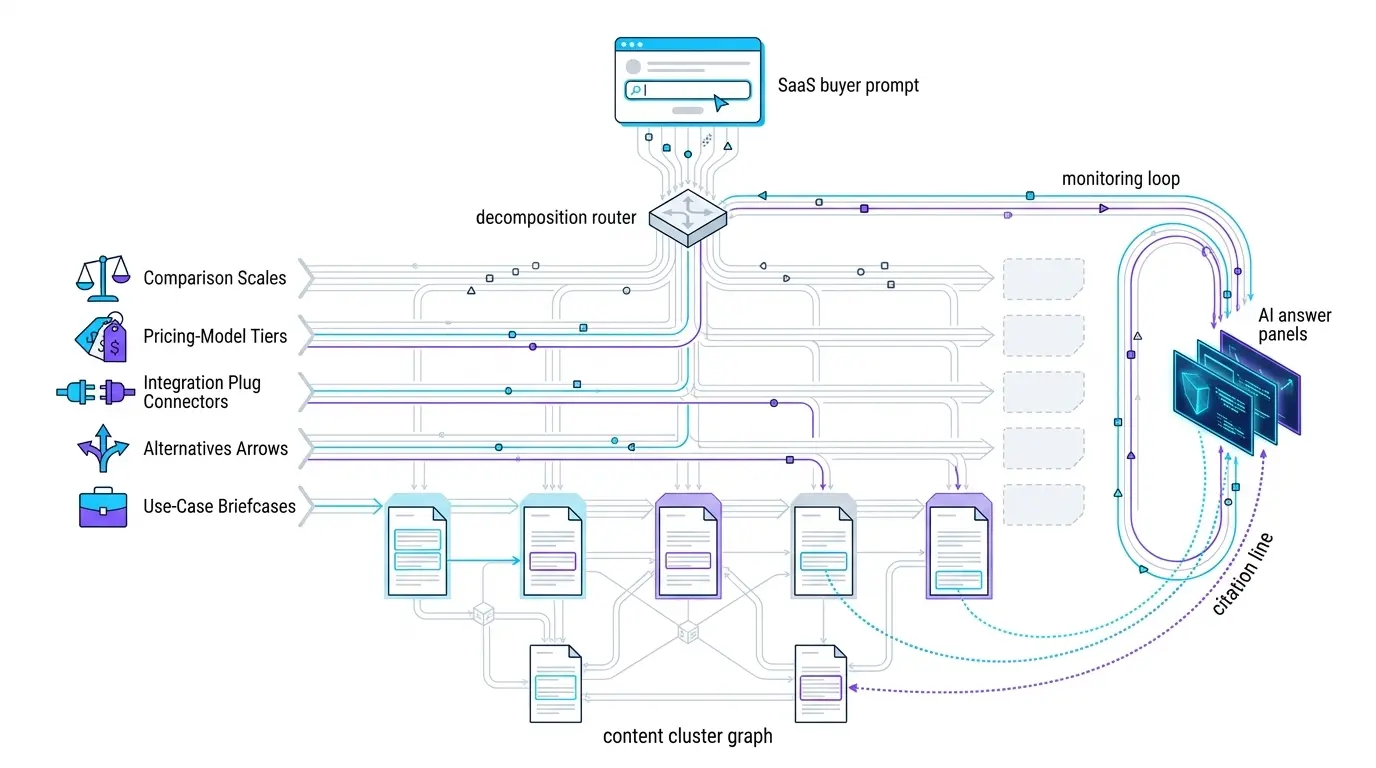
Query fan-out SEO for SaaS means mapping the sub-queries a buyer's AI prompt expands into, then building pages whose passages answer each one cleanly enough to be cited. When a buyer asks an AI assistant which tool fits their team, the system decomposes that prompt into comparisons, pricing models, integrations, alternatives and use cases, retrieves for each, and synthesizes a shortlist. Your category page ranking first for the head term is no longer enough; you need retrievable answers across every branch of that fan-out.
TL;DR
- SaaS buyer prompts fan out into a predictable set of sub-intents: comparison, pricing model, integrations, alternatives, use cases, security and implementation.
- Build a cluster with one page or one clearly headed section per sub-intent, and write each passage to stand alone.
- Measure citation presence for your prompt set in AI answers, not only positions for head terms.
- The manual version breaks at scale; autonomous execution keeps the sub-query map, rewrites and monitoring running.
Not sure what to fix first? Send us your website and we'll email what we'd fix first within 24 hours. Run a free SEO audit →
SaaS Buyer Prompts Fan Out Along Predictable Lines
B2B software purchases follow a consistent evaluation pattern, which makes SaaS one of the most mappable categories for generative engine optimization. A prompt such as "best customer support platform for a 50-person B2B SaaS company that uses HubSpot" will plausibly expand into sub-queries like these:
| Sub-intent | Example sub-query | Page or section that should answer it |
|---|---|---|
| Category fit | support platforms for mid-size B2B SaaS | Category or solution page |
| Comparison | Tool A vs Tool B for B2B support | Head-to-head comparison page |
| Alternatives | alternatives to a named market leader | Alternatives page |
| Integrations | support platform HubSpot integration | Integration page per major partner |
| Pricing model | per-seat vs usage-based support pricing | Pricing page with a model explanation |
| Use case | ticket routing for technical B2B products | Use-case page |
| Security and compliance | support tool SOC 2, data residency | Security or trust page |
| Implementation | migrating support tickets from email | Migration or onboarding guide |
The exact sub-queries any engine generates are not public, and they vary by prompt. The sub-intents above are stable enough to plan against. If you need the underlying mechanics first, read what query fan-out is.
Step One: Build the Prompt Set Before the Keyword List
Keyword research starts from strings with volume. Fan-out planning starts from the prompts your buyers actually type into AI assistants, which are longer, constraint-heavy and rarely show up in keyword databases.
- Collect real language. Pull phrasing from sales call notes, demo request forms, support tickets and review sites. Buyers state constraints there: team size, stack, compliance needs.
- Write 20 to 40 prompts. Each should combine a job to be done with two or three constraints.
- Decompose each prompt. List the sub-intents it implies, using the table above as a template.
- Deduplicate into a sub-query map. Many prompts share branches. The integration and alternatives branches usually recur most.
This map replaces the flat keyword list as your planning artifact. AI-driven strategy tooling generates and maintains it far faster than a spreadsheet.
Step Two: Build a Cluster That Covers Every Branch
Map each branch of the sub-query map to a destination. Some deserve their own page; others belong as a section on an existing page. Avoid two pages answering the same sub-intent, because they compete in retrieval and split entity signals.
For most SaaS sites the gaps sit in three places:
- Integration pages. Many teams list partners in a logo grid with no explanatory text. A logo cannot be retrieved. Each major integration needs a page that states what syncs, in which direction, and what the setup requires.
- Honest comparison and alternatives pages. AI answers favor sources that compare fairly. A comparison page that admits where a competitor fits better is more citable than one that claims to win on every row.
- Pricing-model explanations. You do not need to publish numbers to answer "per-seat or usage-based?" Explaining the model, what drives cost and who each model suits answers the sub-query directly.
Competitor intelligence shows which competitor pages already cover branches you have missed.
Step Three: Structure Every Page for Passage Retrieval
Fan-out systems re-rank passages, not pages. Each section has to win on its own.
- One sub-intent per H2 or H3. "HubSpot Integration: What Syncs and How" beats "Integrations and More."
- Answer in the first sentence. "The HubSpot integration syncs contacts, companies and tickets in both directions every few minutes" is retrievable. Opening with "We're proud to partner with HubSpot" is not.
- Restate the entity. Name your product and the integration in each section instead of "it" or "our platform."
- Include specifics a model can quote. Supported plans, data fields, limits, setup steps, compliance standards. First-party specifics are what competitors cannot copy.
- Use tables for comparisons. Structured rows map cleanly onto comparison sub-queries.
- Keep structured data truthful. SoftwareApplication, Organization and FAQPage markup should match what the page visibly says.
Step Four: Measure Citations, Not Only Rankings
Rank tracking remains necessary for classic results, but it cannot see AI answers composed from sub-queries you never tracked. AI search visibility for SaaS needs its own measurement layer:
- Run your prompt set on a schedule in Google AI Mode or AI Overviews where available, ChatGPT search and Perplexity.
- Record which domains are cited for each prompt and which of your pages appear.
- Track branch coverage. For each branch in your sub-query map, note whether any of your pages is cited.
- Check referral traffic. AI assistants send visible referrals in analytics; segment them and watch which landing pages receive them.
- Compare before and after each content change, so you know which rewrites moved citations.
AI answers vary between runs, so treat single checks as samples and look at trends across repeated runs.
Where Automation Removes the Manual Work
The workflow above is sound, and it does not survive contact with a two-person marketing team. Forty prompts, eight branches each, several engines, rewrites and weekly rechecks add up to more operational friction than most teams can absorb. Legacy diagnostic suites such as Semrush and Ahrefs supply the keyword and backlink data, but their implementation bottleneck is that every next step, from mapping and rewriting to publishing and rechecking, stays manual. The same holds off-page: our guide to automated link building tools for SaaS covers which outreach steps can be handed off safely.
Scalnex closes that loop with AI agents: it clusters keywords, generates and optimizes articles against your brand kit, tracks rankings daily with alerts, analyzes competitors and publishes through its WordPress plugin. The judgment calls stay with your team: which prompts matter, what you will claim, and which comparisons are fair. The repetitive execution moves to the agents. For the crawl and measurement specifics across engines, see how to optimize for Google and ChatGPT search.
FAQ
What is query fan-out SEO for SaaS?
It is the practice of mapping the sub-queries a buyer's AI prompt expands into, such as comparisons, integrations, pricing models and alternatives, then building pages whose sections answer each one directly. The goal is to be retrieved and cited across the whole fan-out, not just ranked for one head term.
How is generative engine optimization for SaaS different from regular SaaS SEO?
The foundations carry over: crawlability, authority and useful content. GEO adds passage-level structure, explicit entity naming, sub-intent coverage and citation measurement. Regular SaaS SEO optimizes pages for queries; GEO optimizes passages for retrieval and synthesis by AI systems.
Which pages matter most for AI search visibility in SaaS?
Integration pages, honest comparison and alternatives pages, pricing-model explanations and use-case pages. These map directly onto the sub-intents buyer prompts generate, and on many SaaS sites they are either missing or written as thin marketing copy that offers nothing quotable.
How often should I recheck AI citations?
Weekly for your highest-value prompts and after every significant content change, monthly for the rest. AI answers vary between runs and change as engines update, so look at trends across repeated checks rather than reacting to a single result.
The verdict for SaaS teams: a workflow that ends at a dashboard leaves every branch of the fan-out as an open ticket, and the backlog grows faster than you can clear it. Autonomous SEO infrastructure turns the sub-query map into shipped pages and measured citations on a schedule. Book a demo to see the agents map your buyer prompts and build the cluster.