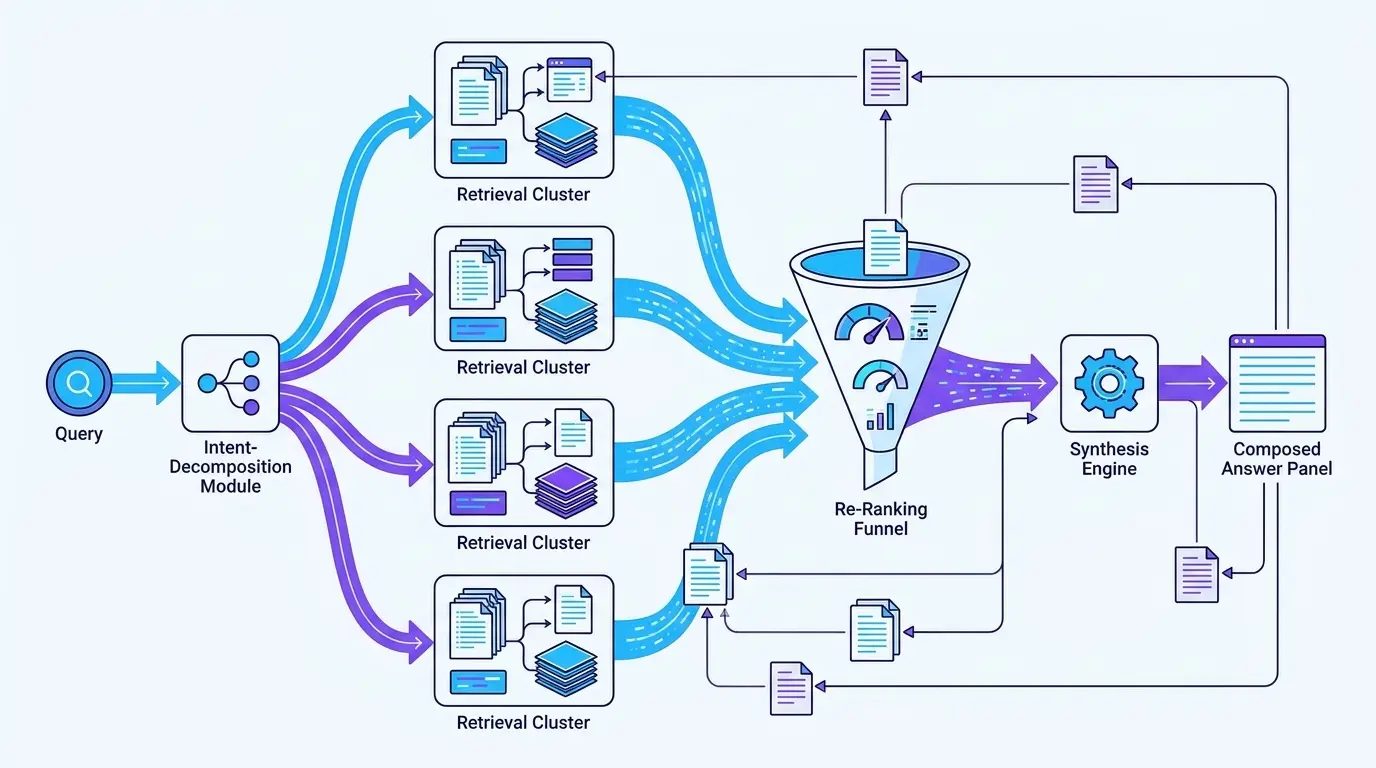
What Is Query Fan-Out? The System Architecture Behind AI Search Retrieval
Query fan-out is the retrieval technique Google has publicly described for AI Mode and AI Overviews: the system expands one user query into many related sub-queries, retrieves results for each in parallel, and synthesizes a single answer with citations. For you, it means a page no longer competes for one query; its individual passages compete across dozens of sub-intents you never targeted directly. Search shifted from ranking documents against a string to assembling answers from evidence, and the pages that get cited are the ones built for that assembly line.
TL;DR
- Query fan-out decomposes one prompt into sub-queries, runs them as parallel retrievals, re-ranks passages and synthesizes a cited answer.
- The unit of competition is the passage, not the page. A strong page with one buried answer loses to a page whose answer stands alone.
- Coverage of sub-intents, entity clarity and self-contained passages decide whether you are retrieved at all.
- Legacy rank tracking measures one query at a time, so it cannot see most of the sub-queries that decide citations.
Not sure what to fix first? Send us your website and we'll email what we'd fix first within 24 hours. Run a free SEO audit →
Query Fan-Out Is a Six-Stage Retrieval Pipeline
Treat fan-out as a data pipeline, because that is what it is. Google has described the behavior at a high level, and the stages below are the standard information-retrieval pattern that description maps to. Exact internal parameters are not public, so avoid anyone who quotes them.
- Query intake. The user enters a long, conversational prompt: "best CRM for a 10-person agency that integrates with Slack and invoices clients."
- Intent decomposition. A language model breaks the prompt into its component needs: CRM for small agencies, Slack integration, invoicing features, pricing models, alternatives to well-known CRMs.
- Sub-query generation. Each need becomes one or more search queries, often including reformulations, comparisons and implicit follow-ups the user never typed.
- Parallel retrieval. The system runs those sub-queries against its index at the same time, pulling candidate documents for each.
- Passage-level re-ranking. Candidates are broken into passages and scored for how directly and reliably each one answers its sub-query.
- Synthesis with citations. The model composes one answer from the top passages and attaches links to the sources it drew from.
The latency budget matters here. Running many retrievals in parallel keeps response time tolerable, which is why fan-out favors content the system can extract and evaluate quickly over content that needs the whole page read to make sense.
Passages, Not Pages, Are the Unit of Competition
In classic ranking, the document is scored as a whole against one query. In fan-out retrieval, the re-ranker evaluates fragments. A 3,000-word guide may contain the single best explanation of Slack integration in its category, but if that explanation depends on context set up four sections earlier, the passage scores poorly in isolation.
This changes how you should write:
- Make every section self-contained. Restate the subject in the first sentence of each section instead of relying on "it" or "this tool."
- Lead with the answer. Put the direct claim first, then the reasoning and evidence. Re-rankers reward passages that resolve the sub-query early.
- Keep one sub-intent per section. A heading that covers pricing, integrations and onboarding at once produces a passage that answers none of them cleanly.
Sub-Intent Coverage Decides Whether You Are Retrieved at All
Fan-out generates queries you did not target. If your cluster covers only the head term, you are absent from most of the retrieval sets that feed the answer. The practical response is to model the sub-queries a prompt is likely to produce and build coverage for each one.
For a commercial prompt, the fan-out typically spans a predictable set of sub-intents: definitions, comparisons, alternatives, pricing models, integrations, use cases, limitations and implementation steps. Map each to a page or a clearly headed section. That mapping exercise is query fan-out SEO in its most concrete form, and it is where AI-driven content strategy earns its keep: generating the sub-query map is fast for a model and slow for a person.
Entity Clarity Lets the System Trust What It Retrieved
Before a passage is cited, the system has to be confident about what it describes. Pages that name entities precisely, such as your product, its category, the integrations it supports and the companies it competes with, give the model clean signals to attach to the claim. Vague positioning copy gives it nothing.
Entity trust compounds across your site. Consistent naming, structured data that matches visible content, and an About page that states what you are all help the system resolve your brand into a known entity. A brand that resolves cleanly is easier to cite than one the model has to guess about.
Traditional Ranking and Fan-Out Retrieval Reward Different Things
| Dimension | Traditional single-query ranking | Query fan-out retrieval |
|---|---|---|
| Input | One query string | One prompt expanded into many sub-queries |
| Unit scored | Whole document | Individual passages |
| Retrieval | One ranked list | Parallel retrievals, then merged re-ranking |
| Output | Ten blue links | One synthesized answer with citations |
| What wins | Page relevance and authority for the query | Self-contained passages that resolve a sub-intent |
| Coverage needed | The target keyword and close variants | Every sub-intent the prompt implies |
| Success metric | Position and click-through | Citation presence across sub-queries |
| Visibility to rank trackers | High | Low: most sub-queries are never tracked |
The semantic layer underneath both columns is covered in the query fan-out vs semantic search guide.
Legacy Diagnostic Suites Cannot See the Fan-Out
Semrush and Ahrefs remain excellent databases for keyword volumes, backlinks and historical rankings. Their implementation bottleneck is structural: they report on queries you specify and pages as whole units. They do not model the sub-queries an AI system generates, and they do not tell you which passage would be retrieved for each one.
That leaves you with passive reporting on a shrinking share of the discovery surface. The gap closes when the work moves from dashboards to autonomous execution: AI agents that generate the sub-query map, audit each page for passage coverage, rewrite weak sections, and track whether citations follow. The broader shift is laid out in traditional SEO vs generative engine optimization.
How to Restructure a Page for Fan-Out Retrieval
Run this sequence on your highest-value commercial pages first:
- List the prompt. Write the long-form question a buyer would actually ask an AI assistant.
- Decompose it. Break the prompt into six to ten sub-intents, the same way the system would.
- Audit coverage. For each sub-intent, find the passage on your site that answers it. Mark gaps and buried answers.
- Rewrite for extraction. Give each sub-intent its own heading, an answer-first opening sentence, and the specific facts that support it.
- Clarify entities. Name products, categories and integrations explicitly; align structured data with the visible text.
- Measure citations. Check which sources AI answers cite for your prompts on a regular schedule, and compare before and after.
Content optimization tooling can automate steps three and four at scale; the judgment about which prompts matter stays with you.
FAQ
What is query fan-out in simple terms?
It is a retrieval method where an AI search system turns one question into many smaller searches, runs them at the same time, and combines the best passages into a single answer with source links. Google has described it as part of how AI Mode and AI Overviews work.
Does query fan-out replace traditional Google rankings?
No. Classic results still appear and still drive traffic, and fan-out retrieval draws on the same index. What changes is that AI answers cite passages across many sub-queries, so strong traditional rankings help but no longer guarantee you appear in the synthesized answer.
How do I know which sub-queries my topic fans out into?
Write the full prompt a buyer would ask, then decompose it into needs: definitions, comparisons, alternatives, pricing, integrations, use cases and limitations. People Also Ask boxes, related searches and AI answer follow-ups reveal the same sub-intents. Models are also effective at generating these maps quickly.
What is the fastest fix for query fan-out SEO?
Rewrite existing high-value pages so each section answers one sub-intent in its first sentence and stands alone without earlier context. This improves passage-level retrieval without new content, and it usually exposes the sub-intents you need to cover next.
The operational verdict is plain: a workflow that reports on single keywords and leaves the passage-level rewrites to a backlog will keep losing citations it never measured. Fan-out turns SEO into a coverage and extraction problem, and that problem rewards autonomous SEO infrastructure over manual diagnosis. Start by finding where your pages break under passage-level retrieval. Run a free SEO audit — no credit card required.